Pascals, brushes and runtime: reading a robot mop’s numbers
5,000, 12,000, 25,000 Pa: the race for pascals is running wild, and runtime is counted in hours. Here is what these figures really measure, what makes good suction and why real-world runtime depends so much on the settings.
Contents
How a robot vacuums
A robot vacuum works like a miniature conventional vacuum cleaner. A motor spins a fan that pushes air out of the robot. This creates a lower pressure under the robot and in the duct than in the room. The surrounding air rushes in to fill the gap and carries dust, crumbs and hair with it into the bin, where a filter traps the particles before the air goes out again.
Two quantities describe this process:
- the pressure drop, that is the pressure difference created, which determines how strongly air is drawn through a narrow opening;
- the airflow, the volume of air moving every second, which determines how much debris is carried.
On a robot, a third dimension matters a lot: space. The motor, battery, bin, water tank and brushes all have to fit into a housing a few centimetres high. The air path is short and narrow, and the main brush plays an even bigger role than on a cylinder vacuum.
Pascals: a pressure drop
The figure highlighted by almost every manufacturer is expressed in pascals (Pa): it is the maximum pressure drop the motor can create. It has risen sharply in a few years, from 2,000 to 3,000 Pa on robots a few generations ago to 20,000 Pa and more on recent models. Roborock claims 25,000 Pa for the Qrevo Edge 2 and 35,000 Pa for the Qrevo Edge 2 Flow, and PCWorld quotes 36,000 Pa for the same manufacturer’s Saros 20 Sonic.
This figure has one major weakness: each manufacturer measures it with its own method. Roborock says so itself in the footnote of its product page: the value comes from its internal tests and results may vary. We do not always know whether the measurement is taken at the motor inlet with the opening blocked, or at the brush, including losses in the air path.
Key point: pascals give an order of magnitude of motor power within the same manufacturer’s range. They do not allow you to say that a 25,000 Pa robot vacuums better than an 18,000 Pa robot from another brand.
Why the race for pascals is misleading
Several reasons explain why a higher figure does not guarantee a better result.
- Airflow is ignored. A strong pressure drop with low airflow does a poor job of lifting light, bulky debris.
- The maximum level is rarely used. The robot only uses full power on certain areas or in a dedicated mode; day to day, it works at an intermediate level.
- Losses are not declared. How well the brush seals against the floor, the length of the duct, the state of the filter: all of these reduce the pressure drop actually available.
- Cleaning speed matters. A robot that moves slowly and goes back over dirty areas can do better than a more powerful but hastier one.
The Maniaques test sums it up well regarding the Qrevo Edge 2: its motor is among the most powerful on the market, but the race for pascals is not everything.
The brush matters as much as the motor
On a rug, it is the main brush that loosens dust from the fibres; suction only carries it away. On a hard floor, a brush that sits flat against the floor picks up both fine dust and larger debris. Three points make the difference.
The material
Rubber brushes, or hybrid rubber and bristle brushes, tangle less than all-bristle brushes and are easier to clean.
Anti-tangle design
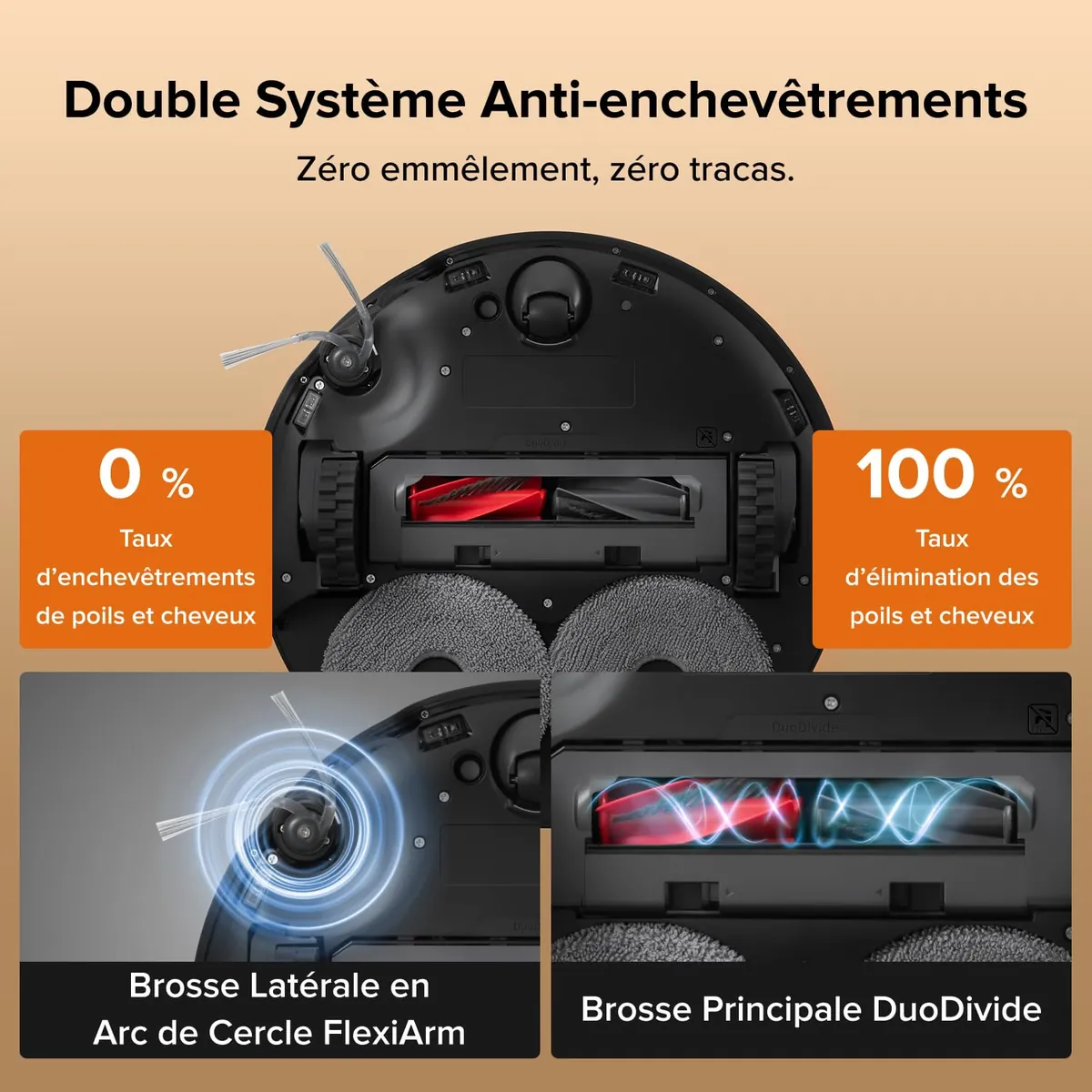
Hair and pet hair wrapped around the brush greatly reduce its efficiency. The Qrevo Edge 2’s DuoDivide brush is split in two in the middle: hair slides towards the centre, where it is sucked up. Roborock claims 0% tangling with hair up to 40 cm long, and Vacuum Wars found no wrapped hair in its test with 18 cm hair.
The side brush
It sweeps dust from edges and corners towards the main brush. A brush that extends, such as the Qrevo Edge 2’s FlexiArm, reaches the skirting boards that round robots often leave untouched.
Independent measurements
Compared with manufacturers’ figures, independent tests that measure what the robot actually picks up are the best reference. The American lab Vacuum Wars, for example, spreads a known quantity of sand into a carpet and weighs what the robot collects. For the Qrevo Edge 2, it measured 94% of sand removed, against 85% for the first Qrevo Edge and an average of 78% for the robots it has tested. On pet hair pressed into a carpet, it scored 89.5%, against an average of 82.2%.
Press tests point the same way. The Allround-PC test praises very high suction on hard floors and excellent suction on carpet; smarthomeassistent.de gives top marks to suction on laminate. These results are worth more than a gap of a few thousand pascals on a specification sheet.
Read the details of the tests: a robot that is excellent on hard floors may be average on thick carpet, or the reverse. Weight the results according to your own floors.
Suction levels
Most robots offer four or five suction levels, plus an automatic mode that increases power on rugs.
| Level | Power | Runtime | Recommended use |
|---|---|---|---|
| Quiet | Low | Maximum | Daily pass, lightly soiled hard floors, when you are at home |
| Balanced | Medium | Intermediate | General use, mixed floors |
| Turbo | High | Reduced | High-traffic areas, pets |
| Max | Maximum | Shortest | Thick rugs, occasional deep clean |
| Automatic | Variable | Optimised | Increases power on rugs and dirty areas |
On the Qrevo Edge 2, SmartPlan 3.0 mode chooses the power for each area itself: boosted suction in high-traffic areas, reduced in Do Not Disturb mode. PCWorld measured 63 dB in balanced mode.
Suction on each type of floor
The same robot does not need the same power everywhere. On smooth hard floors such as tiles, vinyl or laminate, dust lies on the surface: a quiet or balanced level picks it up well, and the brush and side brush do most of the work. Turning up the power mainly shortens the runtime and raises the noise.
Low-pile rugs hold fine dust and hair between the fibres. This is where the automatic carpet boost is useful, together with a main brush that beats the pile. On thick rugs and carpet, the highest levels make a visible difference, but the robot moves more slowly and uses more battery. Grout lines and textured floors are a middle case: a balanced level and a second pass in the kitchen usually give a better result than maximum power once.
Claimed runtime and real-world runtime
The claimed runtime almost always corresponds to the lowest suction level, without mopping, on a hard floor. For the Qrevo Edge 2, the maximum claimed runtime is 180 minutes, and PCWorld mentions up to 295 minutes in quiet mode. These values frame real use without describing it.
Several factors reduce runtime:
- the suction level: Max mode uses much more than quiet mode;
- rugs, which slow the brush down and trigger the automatic power increase;
- mopping, which runs the mop motors and the pump;
- trips back to the dock to wash the mops during a big mopping session;
- clutter, which multiplies detours;
- battery ageing.
In real use, Maniaques cleaned 80 m² by vacuuming then mopping with 18% battery left, and considers the runtime enough for at least 120 m² of simultaneous vacuuming and mopping. Vacuum Wars rates its endurance slightly below that of the first Qrevo Edge. Estimate your own case with our calculator.
Which robot for your home?
Answer a few questions: we suggest the most suitable type of robot and estimate your cleaning time, compared with the maximum runtime claimed for the Qrevo Edge 2.
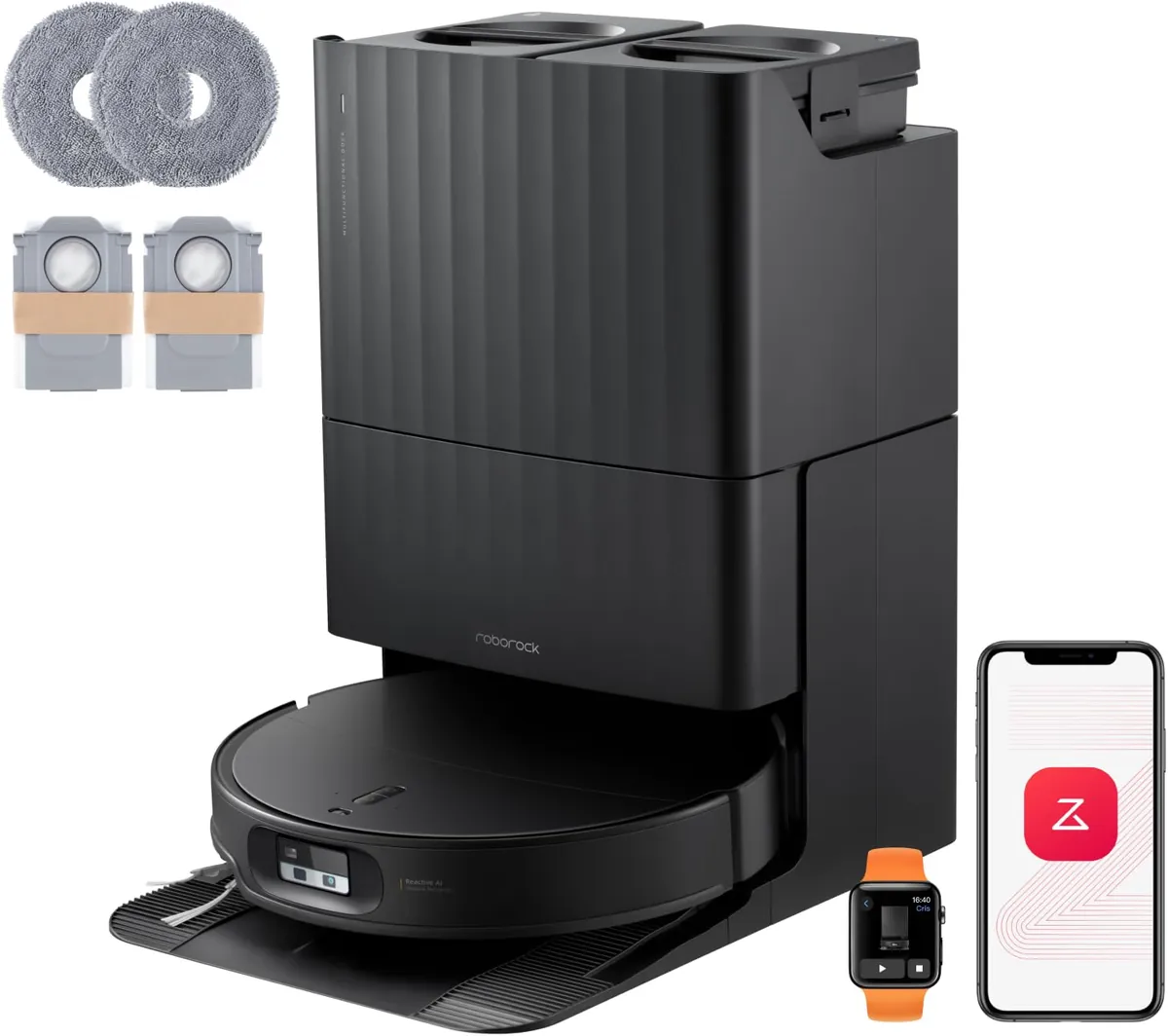
25,000 Pa, 7.98 cm to slip under furniture, a FlexiArm brush for the edges and a dock that washes at 80 °C and dries at 55 °C: enough to forget about the mop and bucket.
- 25,000 Pa
- 7.98 cm
- 80 °C wash
The battery and its lifespan
Robots use lithium-ion batteries, whose capacity is expressed in milliamp-hours (mAh). The Qrevo Edge 2 has 5,200 mAh, as stated by PCWorld and Maniaques, and recharges in under 4 hours according to PCWorld. For comparison, PCWorld quotes 6,400 mAh for the Saros 20 Sonic.
Capacity alone does not predict runtime: it depends on how much the motor, brushes and mopping consume. Two points matter more day to day:
- automatic resume: a robot that goes back to recharge and then resumes where it stopped is never really limited by its battery;
- lifespan: a lithium-ion battery loses capacity over charging cycles and with heat. A robot kept in a temperate room and used at a reasonable suction level looks after it.
After a few years, if the runtime no longer covers your home even though the robot is well maintained, the battery can be replaced on most models. Check that one is available before buying.
Comparing two robots
When faced with two product listings, go in this order:
- Look for an independent test that measures what the robot picks up on your floors. This is the most reliable information.
- Look at the main brush and the anti-tangle system, especially with pets.
- Ignore differences in pascals between different brands.
- Check for automatic resume rather than maximum runtime.
- Compare noise at the suction level you will actually use.
- Think about the rest: height, thresholds, dock and navigation matter as much as suction day to day.
Our guide on how to choose a robot vacuum mop covers every criterion, with a checklist.
Common misconceptions
- “More pascals means a cleaner home.” The brush, airflow and navigation matter just as much.
- “Max mode cleans better everywhere.” On a clean hard floor, a moderate level picks up just as well and spares the battery and your ears.
- “A big battery is enough for a large house.” What counts is automatic resume after recharging.
- “Suction always drops over time.” It mainly drops if the filter and brush are not maintained.
Keeping suction strong
The claimed power applies to a new, clean robot. To keep it: let the dock empty the bin, clean the filter regularly, remove hair from the brushes and wheels, and change the dock’s bag when it is full. On the Qrevo Edge 2, Maniaques recommends checking the filter every fortnight, as it clogs fairly quickly. Our guide to robot mop maintenance details the method.
A change in sound is often the first sign: a new whistle or a higher-pitched noise almost always points to restricted airflow, caused by a clogged filter, a full bin or an obstructed brush.
The Qrevo Edge 2 in figures
| Data | Value | What it means |
|---|---|---|
| Suction | 25,000 Pa (Roborock internal tests) | A powerful motor, to be compared with independent measurements |
| Carpet (Vacuum Wars) | 94% of sand removed, average 78% | A very good measured result |
| Pet hair (Vacuum Wars) | 89.5%, average 82.2% | Above average |
| Tangling | 0% | Claimed by Roborock, confirmed by Vacuum Wars |
| Battery | 5,200 mAh, charged in under 4 h | A large area on one charge, with resume if needed |
| Noise | 63 dB in balanced mode (PCWorld) | A typical level for a robot |
These values place the Qrevo Edge 2 among the most effective robots in its range for suction, without making it a champion at threshold climbing or scrubbing. All the details are in our specifications explained and our full review.
Frequently asked questions
Is 25,000 Pa a lot?
It is a high value for a robot, taken from the manufacturer’s internal tests. It cannot be compared directly with another brand’s pascals.
Why does my robot run for less time than claimed?
The claimed runtime applies at the lowest suction level, without mopping. With strong suction, rugs and mopping, it drops significantly.
Does Max mode damage the battery?
It puts more strain on it and drains it faster. Use it on the areas that need it rather than all the time.
What should you do if suction drops?
Check the filter, the bin, the main brush, the wheels and the dock’s bag. In most cases, a clean is enough.
Can a robot vacuum as well as a cylinder vacuum?
For everyday cleaning, the best robots come close, mainly thanks to their daily passes. For a deep clean of thick carpet, a cylinder vacuum keeps the advantage of continuous power.
How long does a robot take to recharge?
A few hours in general; under 4 hours for the Qrevo Edge 2 according to PCWorld. The robot then resumes the interrupted clean.
What battery capacity should you aim for?
For an ordinary home, most current robots are enough. Above all, check for automatic resume after recharging, which is more useful than a big capacity.
Does the suction level affect noise?
Yes, a lot. Quiet mode suits times when you are at home; keep the higher levels for when you are out.
Is a higher suction level better for pet hair?
On rugs, a boosted level helps lift pet hair from the fibres. On hard floors, a balanced level is usually enough, and an anti-tangle brush matters more than extra power.
Clean floors, without thinking about it.
25,000 Pa · 7.98 cm · 80 °C wash · 55 °C drying · over 280 object types recognised. The price changes often on Amazon: check it, along with the seller, the exact version (Set, X, Pro) and the accessories included, before you order.
Check the price on AmazonAffiliate link · new tab