How to choose a robot vacuum mop: the complete guide
Tens of thousands of pascals, docks that “do it all” and hundreds of recognised obstacles: robot mop listings all look alike and muddy the waters. Here are the criteria that really matter, with clear benchmarks, the traps to avoid and the right robot for each home.
Contents
Start from your home, not the numbers
There is no best robot vacuum mop in absolute terms. There is a robot suited to your floor area, your floors, your furniture, your thresholds, your pets and the way you live. Before comparing specification sheets, answer six simple questions. They rule out half the models straight away and stop you paying for features you do not need.
- How much floor area needs cleaning? A 25 m² studio and a 140 m² house do not have the same needs in terms of runtime or tank capacity.
- Which floors dominate? Tiles, lacquered wood, oiled wood, vinyl, low-pile or thick rugs: they change the mopping system and the useful settings.
- Do you have a dog or a cat? Hair wraps around the brushes and fills the bin, and pet waste calls for good object recognition.
- How much clearance is under your furniture? Measure under the bed and the sofa: a few millimetres decide whether the robot gets through.
- How high are your thresholds? Measure door sills and transitions between rooms: a robot that gets stuck cleans nothing.
- Where will the dock go? You need a wall, a socket, a hard floor and clearance in front of it.
Write down your answers: they will serve as a reading grid for each criterion that follows. Our calculator does part of this work in a few seconds, by estimating your cleaning time and comparing it with the claimed runtime.
Think about your routine too. A household that wants a clean floor every day without thinking about it does not have the same expectations as someone who just wants a quick clean before the weekend. Regularity is a robot’s great strength; it should guide your choice more than maximum power.
The families of robots
Very different appliances hide behind the same name. Telling them apart stops you comparing a back-up robot with one designed to look after a whole house on its own.
| Family | Who it is for | Limits |
|---|---|---|
| Simple robot vacuum | Small areas, dust control | No mopping, manual emptying |
| Robot vacuum mop without a dock | Small homes, small budgets | Mop to wash by hand, tank to fill |
| Robot mop with an emptying dock | Homes with pets, medium-sized homes | Mop to wash by hand |
| Robot mop with a complete dock | Anyone who wants upkeep with almost no intervention | Price, size of the dock |
| Roller robot mop | Large hard floors mopped often | Newer, often more expensive |
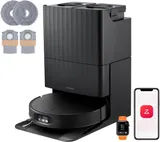
The Roborock Qrevo Edge 2 belongs to the fourth family: a spinning-mop robot with a dock that empties, washes in hot water, dries and refills. Our full review looks at it in detail.
Criterion 1: suction and brushes
This is the first figure people look at, and the most misunderstood. Manufacturers express it in pascals (Pa): the maximum pressure drop the motor can create. In a few years it has gone from 2,000 or 3,000 Pa to more than 20,000 Pa on recent models. Roborock claims 25,000 Pa for the Qrevo Edge 2.
Three caveats apply. Each brand measures in its own way, often in internal tests, as Roborock states in the notes on its product page: pascals therefore cannot be compared from one brand to another. The pressure drop says nothing about airflow, which carries the debris. And efficiency depends as much on the brush as on the motor: it is the brush that loosens dust from rug fibres.
The main brush
Rubber or hybrid brushes tangle less than bristle brushes. Recent models add anti-tangle systems: a comb, a conical brush or, on the Qrevo Edge 2, a DuoDivide brush split in two in the middle, rated at 0% tangling with hair up to 40 cm long.
The side brush
It sweeps dust from the edges towards the main brush. An extending side brush, such as the Qrevo Edge 2’s FlexiArm, reaches further into corners and under kickboards.
Practical benchmark: for a home with rugs and pets, look for independent measurements on carpet and pet hair rather than the Pa figure alone. Vacuum Wars, for example, measured 94% of sand removed from a carpet for the Qrevo Edge 2, against an average of 78%. Our article on suction, pascals and runtime explains these units in detail.
Criterion 2: the mopping system
This is the biggest difference between two robot mops. Four systems coexist.
- The dragged pad: a damp textile fixed under the robot. Simple and inexpensive, it mops lightly and gets dirty quickly.
- The vibrating plate: the pad vibrates to scrub better. More effective, but the edges are still poorly covered.
- Spinning mops: two discs rotate while pressing on the floor. They scrub well, lift on rugs and one can extend towards the walls. This is the Qrevo Edge 2’s choice: 200 rpm and 8 N of pressure according to Roborock.
- The roller: a textile cylinder rinsed continuously with clean water. It always mops with clean water, but it is newer and often more expensive.
Also look at mop lifting, which protects rugs: 12 mm on the Qrevo Edge 2, which can also leave its mops at the dock before vacuuming a thick rug. Adjustable water flow, across 30 levels on this model, lets you protect a wood floor. Downward pressure matters for stains: 8 N is enough for everyday cleaning, but dried-on stains often need several passes, as PCWorld and Maniaques found.
Criterion 3: the dock
The dock makes the difference between a robot that needs daily care and an almost self-sufficient appliance. List what it takes care of:
- Automatic emptying of the bin into a bag: essential with pets.
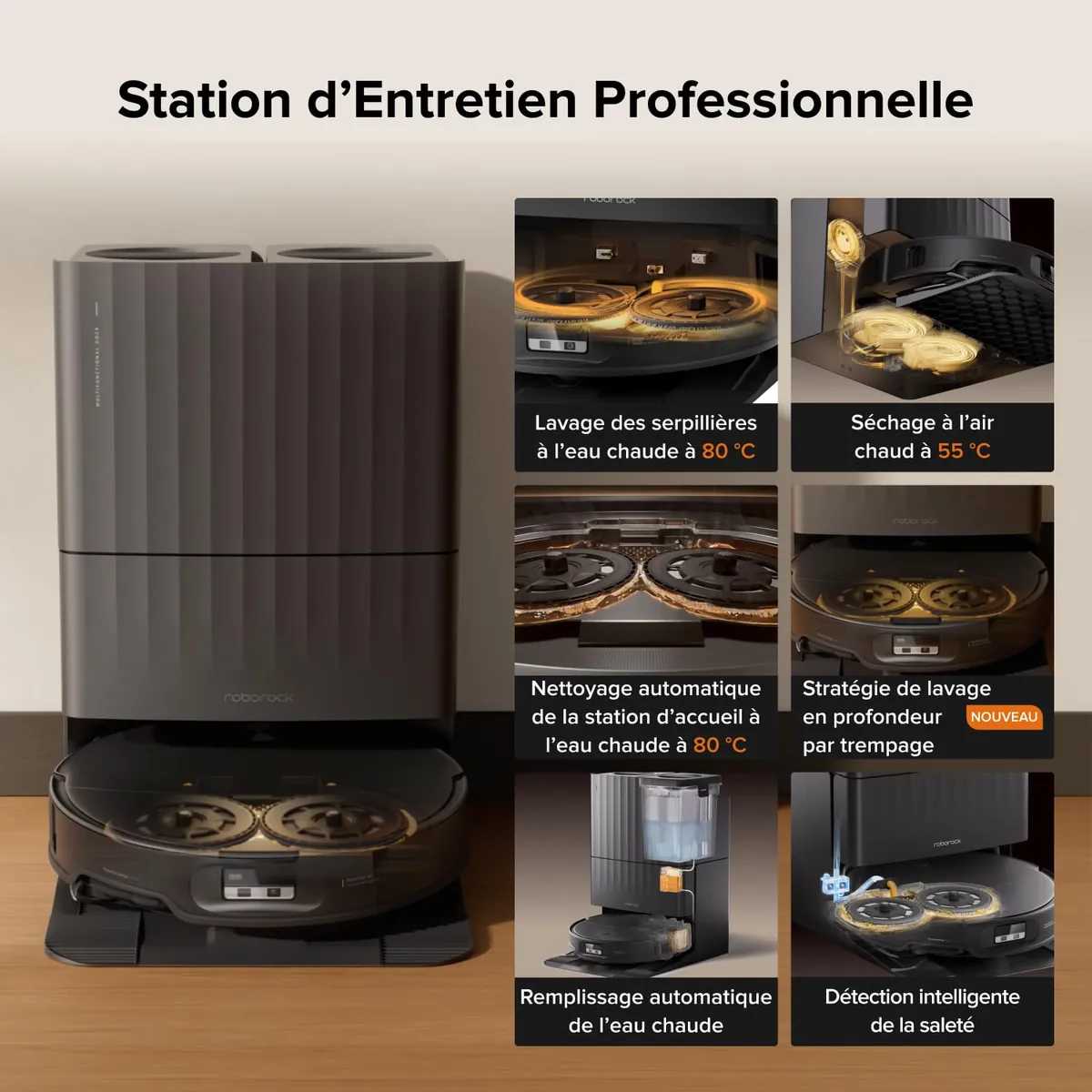
- Mop washing, ideally in hot water: up to 80 °C on the Qrevo Edge 2.
- Warm-air drying to prevent smells: 55 °C on this model.
- Automatic refilling of the robot’s tank.
- Detergent dosing: absent on the Qrevo Edge 2, you add the product by hand.
- A detachable base to clean the washing area.
Think about noise too: automatic emptying is the loudest phase, for a few seconds. Scheduling sessions while you are out solves the problem, but a robot that comes back to empty itself late in the evening in a small flat can be a nuisance.
Think about the space it takes. The Qrevo Edge 2’s dock is 34 cm wide, 48.7 cm deep and 52.1 cm high according to Roborock. Some models also offer docks that connect to the water supply and drain, which are convenient but harder to install. Our guide to the robot mop docking station reviews each function.
Criterion 4: navigation
A robot that knows where it is cleans faster and more thoroughly. Entry-level models find their way with a gyroscope or a ceiling-facing camera; almost all current models use a laser rangefinder, the LiDAR, which draws an accurate map of the home.
The map is then used for everything: dividing rooms, setting each one separately, drawing no-go zones, choosing the cleaning order and resuming after a recharge. A robot without a reliable map goes over the same spots several times and misses others; a well-mapped robot covers the home in regular rows and always knows where its dock is.
Check how quickly it maps, how well it divides rooms, how it handles several floors and whether you can draw no-go zones. The Qrevo Edge 2 maps about 70 m² in under 5 minutes according to PCWorld, and its LiDAR retracts to get under low furniture. Our article on navigation, mapping and obstacles goes deeper.
Criterion 5: obstacle avoidance
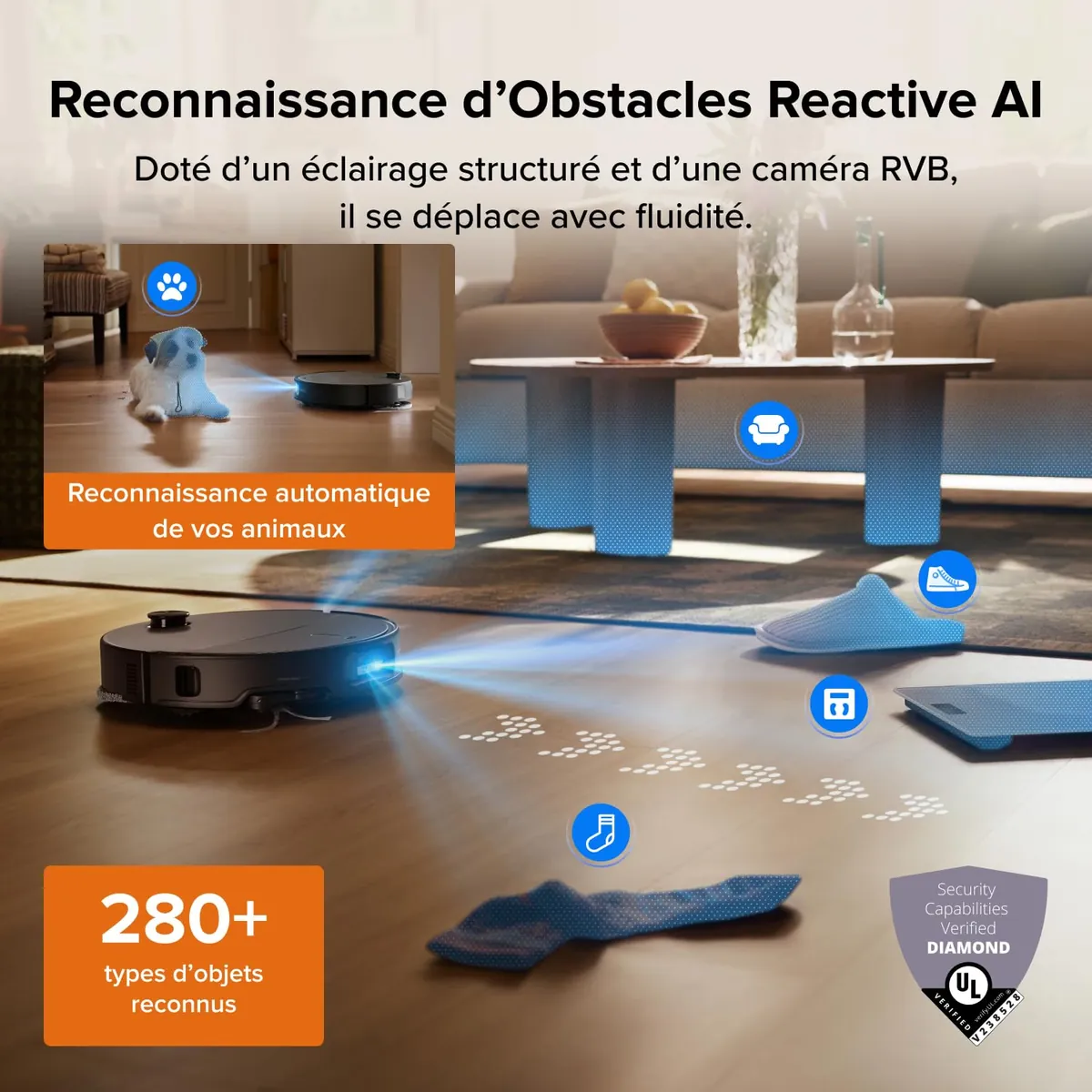
The front camera, often combined with structured light, identifies objects on the floor so the robot can go around them: socks, cables, slippers, pet bowls, pet waste. Manufacturers state a number of recognised categories, more than 280 for the Qrevo Edge 2 with Reactive AI technology.
This figure is not a success rate. In tests, the results are more nuanced: 14 obstacles avoided out of 24 for Vacuum Wars, difficulties with thin cables and flat objects for PCWorld, a Lego brick hit for Maniaques. If your floor is often cluttered, favour the models rated best on this point, and keep the habit of a quick tidy.
Criterion 6: robot height
Most robot mops are between 9 and 10 cm tall because of the LiDAR turret. They do not fit under a low bed or sofa, which is exactly where dust builds up. A few models retract their LiDAR: the Qrevo Edge 2 goes down to 7.98 cm this way.
Measure the clearance under your furniture with a tape measure, in several places, and keep a few millimetres of margin for uneven floors. If the robot only just fits, it can also get stuck: a no-go zone is better than a robot trapped every morning.
Criterion 7: threshold climbing
This is the most often forgotten criterion, and one of the most frustrating. Conventional robots climb about 2 cm; some recent models with a chassis that lifts up go much higher. The Qrevo Edge 2 is in the average: about 20 mm according to PCWorld and Vacuum Wars, 2.5 cm according to Maniaques, and a 3 cm obstacle stops it.
Measure your door sills, transition strips and the edges of thick rugs. Beyond the robot’s capacity, there are three solutions: a small ramp, a separate map for each area, or a model that climbs higher.
Criterion 8: edges and corners
A round robot often leaves a thin strip of dust along skirting boards and in corners. Manufacturers respond with side brushes and mops that extend. On the Qrevo Edge 2, the FlexiArm brush and one mop reach for the edges, and Roborock claims cleaning under kitchen kickboards up to 2.5 cm deep. In a kitchen, Maniaques found that the dust at the foot of the kickboards was picked up well.
Criterion 9: runtime and resume
The claimed runtime almost always corresponds to the most economical setting. With strong suction and mopping, it is shorter, and the robot also goes back to wash its mops along the way. The Qrevo Edge 2 has a 5,200 mAh battery and a maximum claimed runtime of 180 minutes; Maniaques cleaned 80 m² by vacuuming then mopping with 18% battery left.
More than the duration, check for automatic resume: a good robot goes back to recharge and resumes where it stopped. For a large house, that is what counts. To estimate your needs:
- allow about 1 minute per m² for vacuuming and mopping on hard floors;
- a little more on mixed floors, because of mop lifting and detours;
- add a margin with a pet.
Which robot for your home?
Answer a few questions: we suggest the most suitable type of robot and estimate your cleaning time, compared with the maximum runtime claimed for the Qrevo Edge 2.
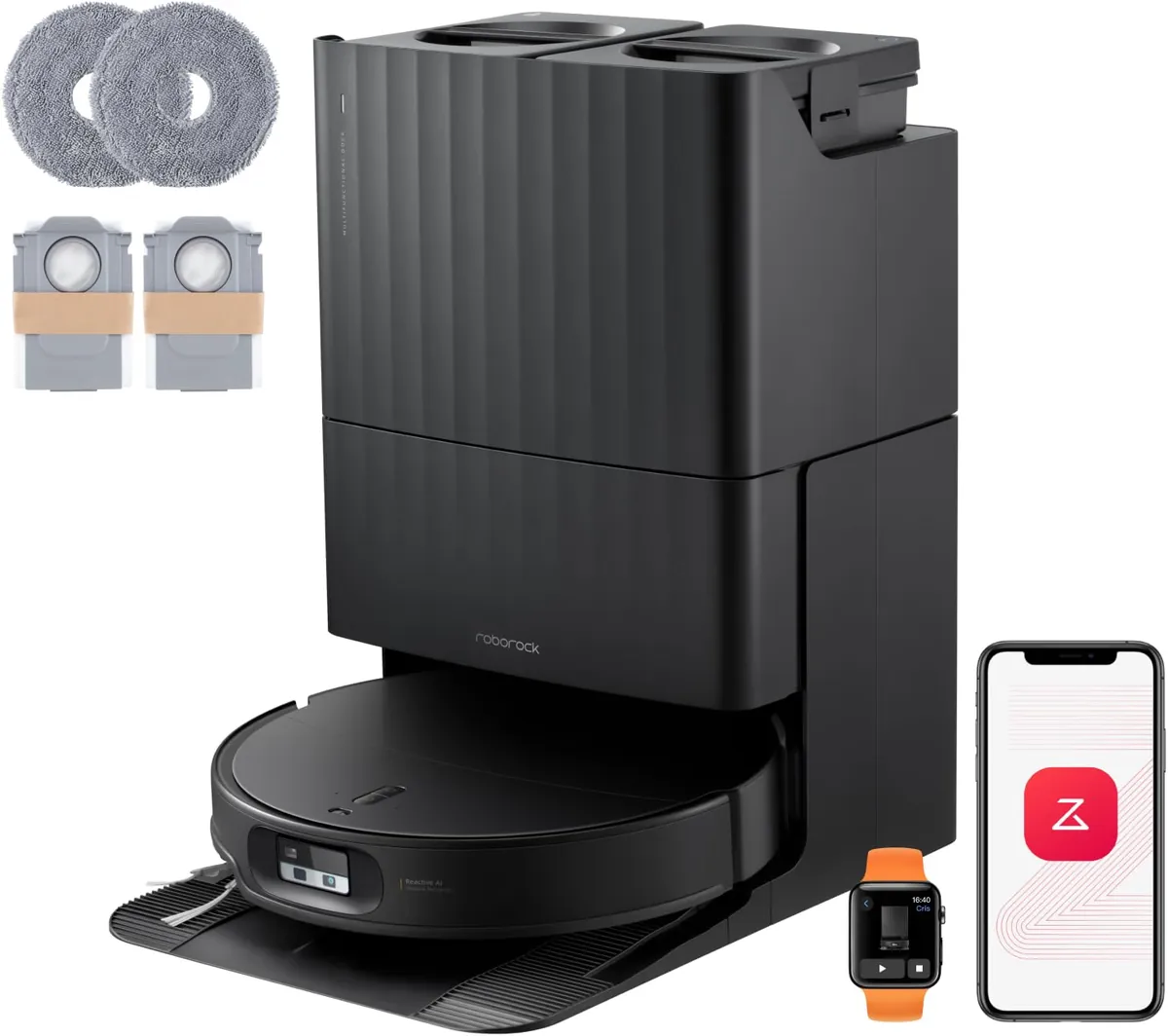
25,000 Pa, 7.98 cm to slip under furniture, a FlexiArm brush for the edges and a dock that washes at 80 °C and dries at 55 °C: enough to forget about the mop and bucket.
- 25,000 Pa
- 7.98 cm
- 80 °C wash
Criterion 10: the app and the smart home
The app is your everyday remote control. Check that it lets you name and divide rooms, manage several floors, set suction and water flow room by room, draw no-go and no-mop zones, schedule sessions and track the wear of consumables.
On the smart-home side, Matter compatibility makes integration with Alexa, Siri or Google Home easier. The Qrevo Edge 2 offers it, along with a built-in voice assistant, Hello Rocky, which responds even without a connection according to Roborock. One practical point not to forget: many robots, including this one, only work on 2.4 GHz Wi-Fi.

Criterion 11: upkeep and consumables
A robot mop uses bags for the dock, mops, filters and brushes. Before buying, check that these parts are easy to find and how much they cost. Also look at the tasks you will still have to do: empty the dirty water, clean the filter, remove hair from the wheels, rinse the dock’s base. On the Qrevo Edge 2, Maniaques recommends checking the filter every fortnight. Our guide to robot mop maintenance gives the full schedule.
Criterion 12: reliability, guarantee and parts
- The guarantee: in the UK, the Consumer Rights Act gives you rights against the seller if the goods are faulty. The manufacturer may add its own guarantee; two years for the Qrevo Edge 2 according to PCWorld.
- The repairability index displayed in France shows how easy the appliance is to take apart and how available the parts are: retailers display 8.8 out of 10 for the Qrevo Edge 2X variant.
- Buyer reviews that mention breakdowns, the battery and after-sales service are more instructive than those written on delivery day. Our review summary for the Qrevo Edge 2 sums them up.
Robot vacuum only, or robot mop?
Before comparing robot mops, ask yourself whether you need mopping at all. A robot that only vacuums is simpler, has no water to manage and no mops to look after, and its dock is smaller. It suits homes that are mostly carpeted, households that already mop by hand once a week and are happy to keep doing so, and people who want the least possible upkeep.
A robot mop makes sense as soon as hard floors dominate: tiles in the kitchen and bathroom, laminate or lacquered wood in the living areas. Daily vacuuming removes the dust; regular light mopping removes the footprints, splashes and sticky marks that build up in between. With a dock that washes and dries the mops, the extra upkeep is limited to the water tanks.
One rule of thumb: if you currently get the mop out more than once a week, a robot mop with a complete dock will save you real time. If you rarely mop, a good robot vacuum with automatic emptying may be all you need, and you can keep the difference in budget for a better model in that category.
The right robot for your profile
| Your profile | What you need |
|---|---|
| Studio or small flat with hard floors | A simple robot mop, possibly without a complete dock |
| Family flat, mixed floors | A spinning-mop robot with a dock that washes and dries |
| Low furniture, low beds and sofas | A robot with a retractable LiDAR, under 8 cm |
| Dog or cat | Tangle-free brushes, automatic emptying, pet-waste recognition |
| High thresholds, thick rugs | A robot that climbs high, with a lifting chassis |
| Large hard floors mopped often | A roller robot or one with high pressure |
| House on several levels | Multi-map management, or even one robot per floor |
To find out whether a robot is enough or needs a stick vacuum alongside it, see our comparison of robot mops, stick vacuums and cylinder vacuums. For pets, our guide to pet hair goes further.
What you get at each budget
Robot mop prices cover a wide range and change often, between promotions and new generations. Rather than amounts that quickly go out of date, here is what you generally get at each level.
Entry level
Robots that vacuum properly and mop with a dragged pad, without a dock or with a simple charging base. Navigation can be basic and obstacle avoidance absent. They look after a small, uncluttered home, provided you accept washing the pad and emptying the bin yourself.
Mid-range
The largest category: LiDAR, spinning mops or a vibrating pad, an emptying dock and sometimes a washing dock, a full-featured app. It is often the best value for a family home without special constraints.
High end
A complete dock with hot-water washing and drying, a camera to avoid objects, tangle-free brushes, sometimes a retractable LiDAR, an extending arm or a lifting chassis. The Qrevo Edge 2 sits on the border between mid-range and high end: it offers a large share of the features, without automatic detergent dosing or the high threshold climbing of the most expensive models.
Our advice: start from your real needs and choose the lowest level that covers them. An 80 °C dock adds little in a tiled studio with no pets. Conversely, saving on the dock and brushes when you have a dog and mixed floors quickly costs you in chores.
The most common buying mistakes
Feedback from disappointed buyers is very similar. Most disappointments come from a gap between the intended use and what the robot does, not from a defect in the product.
- Choosing on pascals. A high figure guarantees neither a good brush nor good mopping.
- Forgetting to measure. Height under the furniture, height of the thresholds, space for the dock: three measurements that avoid most disappointments.
- Believing the robot scrubs. It maintains; dried-on stains often need several passes or a quick mop by hand.
- Overlooking the Wi-Fi. Many robots only accept 2.4 GHz.
- Underestimating upkeep. Dirty water, the filter, hair in the wheels: a few minutes a week are still needed.
- Buying without checking the version. Two listings with similar names can have a different dock or mopping system.
- Mopping an oiled wood floor. Check that your flooring can take damp mopping.
Avoiding these mistakes only takes a few minutes of thought before buying. That is exactly what the checklist below is for.
A final tip: narrow your selection down to two or three models that tick all the essential boxes, then decide between them using independent tests and buyer reviews written after several months. At that stage, the differences between good robots are often smaller than those between your own floors and habits.
The traps in product listings
Some phrases come up again and again. Knowing them avoids unpleasant surprises.
- “25,000 Pa”: a maximum pressure drop measured with the manufacturer’s method. Compare independent measurements on carpet instead.
- “Up to 180 minutes”: at the most economical setting. With mopping and strong suction, it is less.
- “Over 280 obstacles”: learned categories, not an avoidance rate.
- “65 days without emptying”: a maximum value; with pets, expect less.
- “80 °C washing”: the temperature of the water that washes the mops in the dock, not the floor.
- “Forget pre-cleaning”: partly true, but thin cables remain a trap.
- Struck-through prices: the reference price is sometimes theoretical. Compare the prices actually charged over a few weeks.
The checklist before you buy
- I have measured the height under my furniture and it is greater than the robot’s height, with a margin.
- My thresholds stay below the stated climbing capacity.
- I have a spot for the dock: wall, socket, hard floor, clearance.
- The mopping system suits my floors, and my wood floor can take damp mopping.
- The dock does what I need: emptying, washing, drying, refilling, detergent.
- The brushes resist tangling if I have pets or long hair.
- My Wi-Fi offers a 2.4 GHz band if the robot requires it.
- Spare bags, mops, filters and brushes are easy to find.
- I have checked the exact version and what is in the box.
- I have read buyer reviews written after several months of use.
Frequently asked questions
What is the most important criterion when choosing a robot mop?
How well the robot fits your home: height under the furniture, thresholds, floors and pets. Then come the dock and the mopping system. Power in pascals comes after that.
How many pascals do you need?
Beyond a few thousand pascals, the brush and the airtightness matter as much as the figure. Compare independent measurements on carpet and pet hair rather than Pa from one brand to another.
Is a complete dock worth it?
For a robot mop used often, yes: it washes and dries the mops, prevents smells and frees you from daily chores. In a studio that does not get very dirty, it is less useful.
Spinning mops or roller?
Spinning mops scrub well, lift and reach into corners; a roller always mops with clean water, which is useful on large hard floors. Both look after an ordinary home well.
Is a robot mop suitable for wood floors?
For lacquered wood or laminate, yes, with little water. Oiled or waxed wood floors do not cope well with moisture: check your flooring instructions.
Do you need a camera?
It helps a lot with pets, children or a floor that is often cluttered. It does not replace a quick tidy of thin cables.
What maximum height to get under a bed?
Measure your clearance: a 7.98 cm robot like the Qrevo Edge 2 gets through where conventional 9 to 10 cm models get stuck.
Is a cheap robot a false economy?
Not in a small, uncluttered home. It becomes one with pets, mixed floors or a large area: a pad to wash, a bin to empty and an imprecise map soon wear you down.
Can you trust star ratings in online shops?
As a trend, not as a measurement. Read reviews written after several months and look for recurring points: thresholds, mopping, reliability, after-sales service.
Does a robot mop work without Wi-Fi?
A basic clean can often be started from the button on the robot, but the map, room settings and scheduling go through the app and therefore through Wi-Fi. On the Qrevo Edge 2, the Hello Rocky voice assistant responds even without a connection according to Roborock.
How long does a robot vacuum mop last?
Several years with regular upkeep. The battery, brushes and mops wear out first: check before buying that they are easy to replace and that parts are available.
Clean floors, without thinking about it.
25,000 Pa · 7.98 cm · 80 °C wash · 55 °C drying · over 280 object types recognised. The price changes often on Amazon: check it, along with the seller, the exact version (Set, X, Pro) and the accessories included, before you order.
Check the price on AmazonAffiliate link · new tab