Robot vacuum mop: it gets everywhere.
Which robot vacuum mop should you choose in 2026? Our criteria (suction, mopping, dock, navigation, obstacles, height), our practical guides and our reference model, the Roborock Qrevo Edge 2: 25,000 Pa, just 7.98 cm tall and a dock that washes the mops at 80 °C.
- 25,000 PaSuction
- 7.98 cmHeight
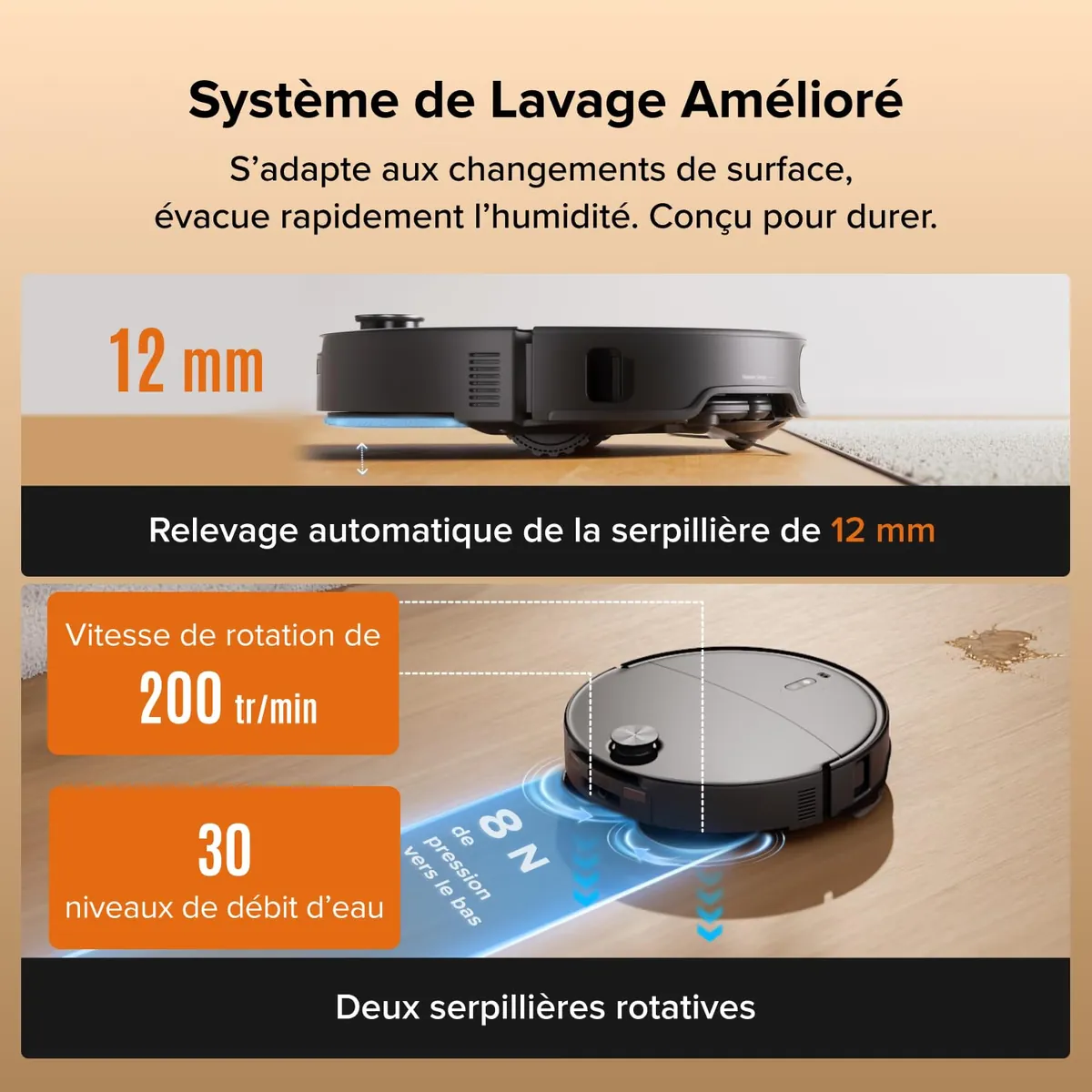
- 8 NPressure
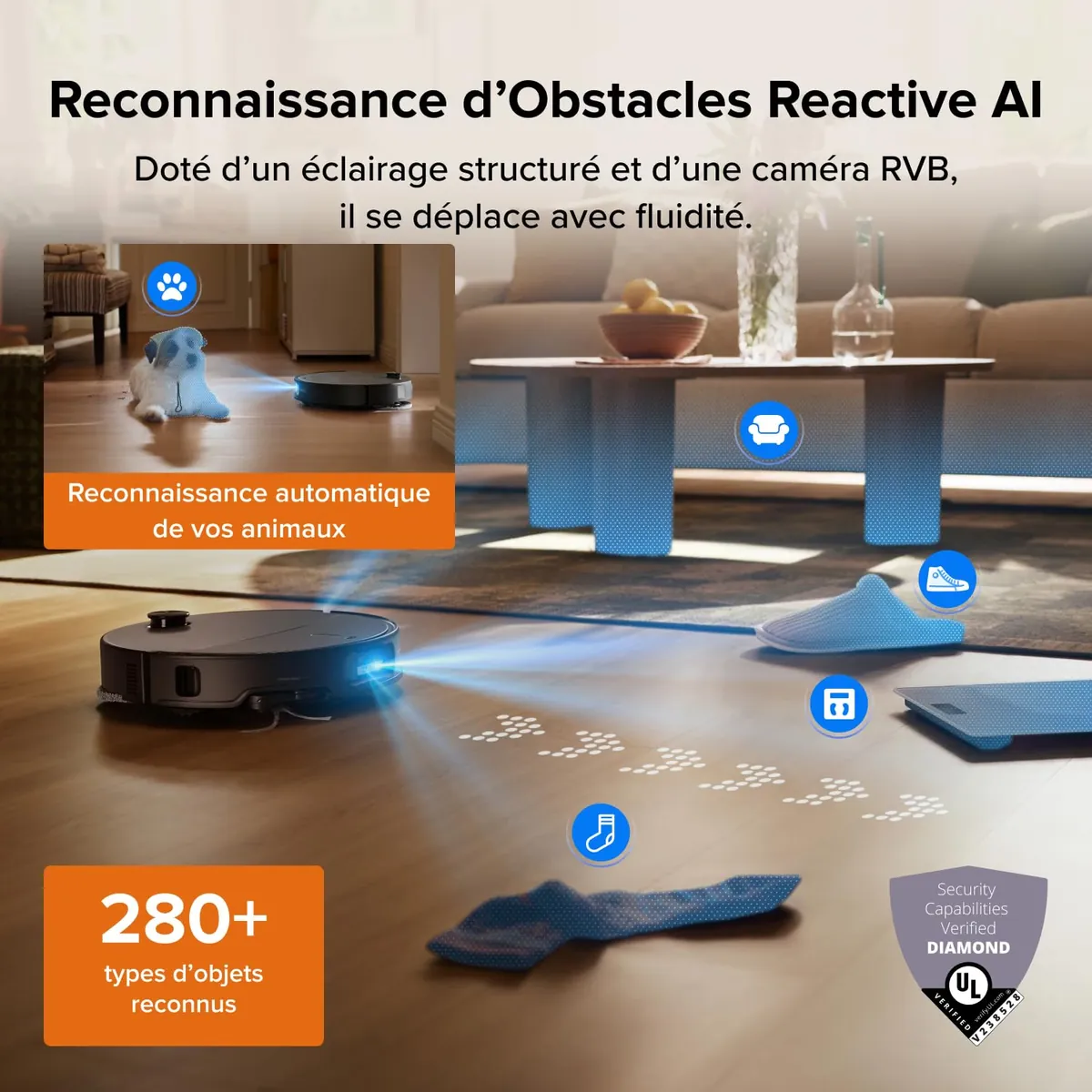
- 280+Objects
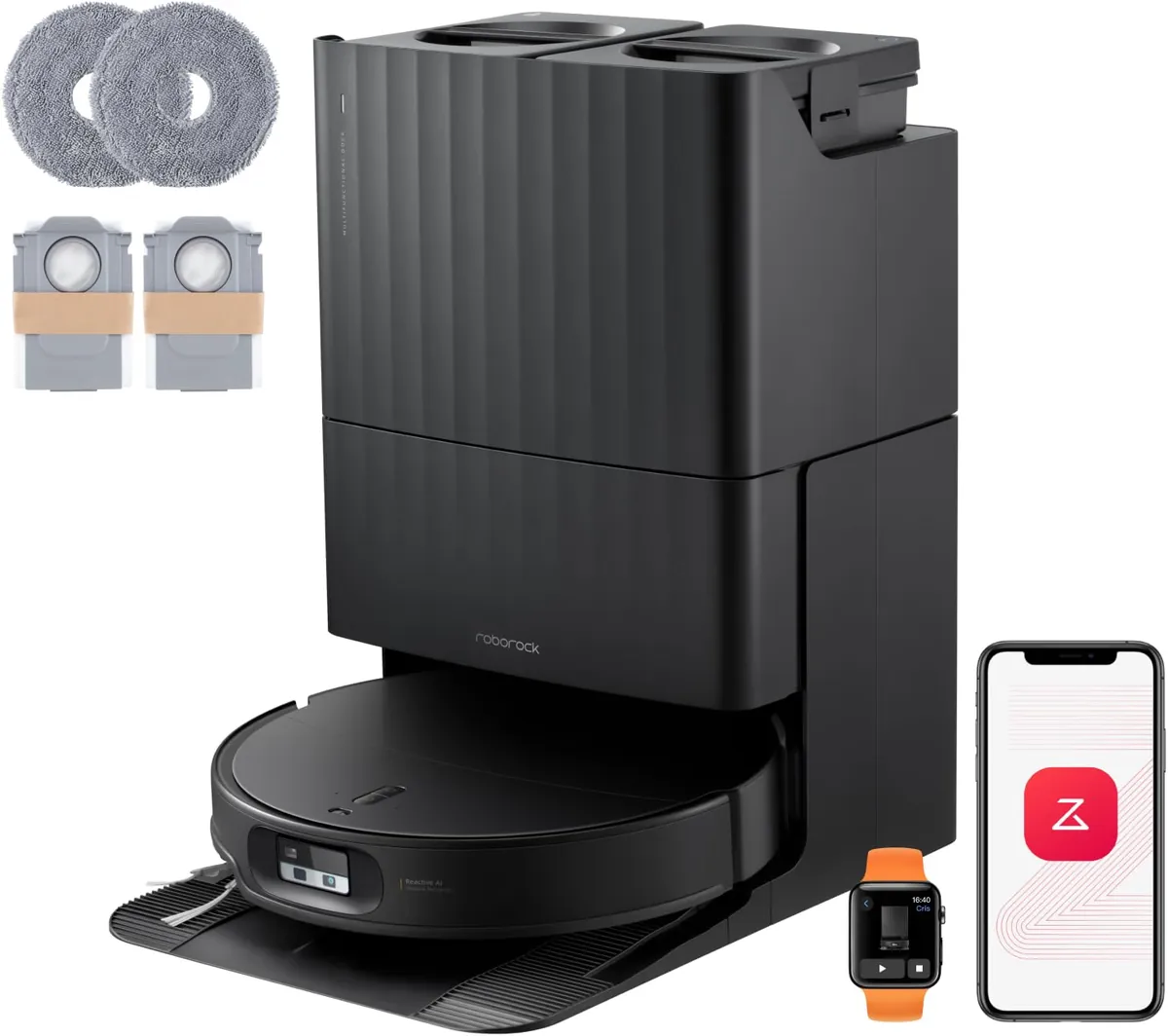
- 25,000 Pa
- 7.98 cm ultra-slim
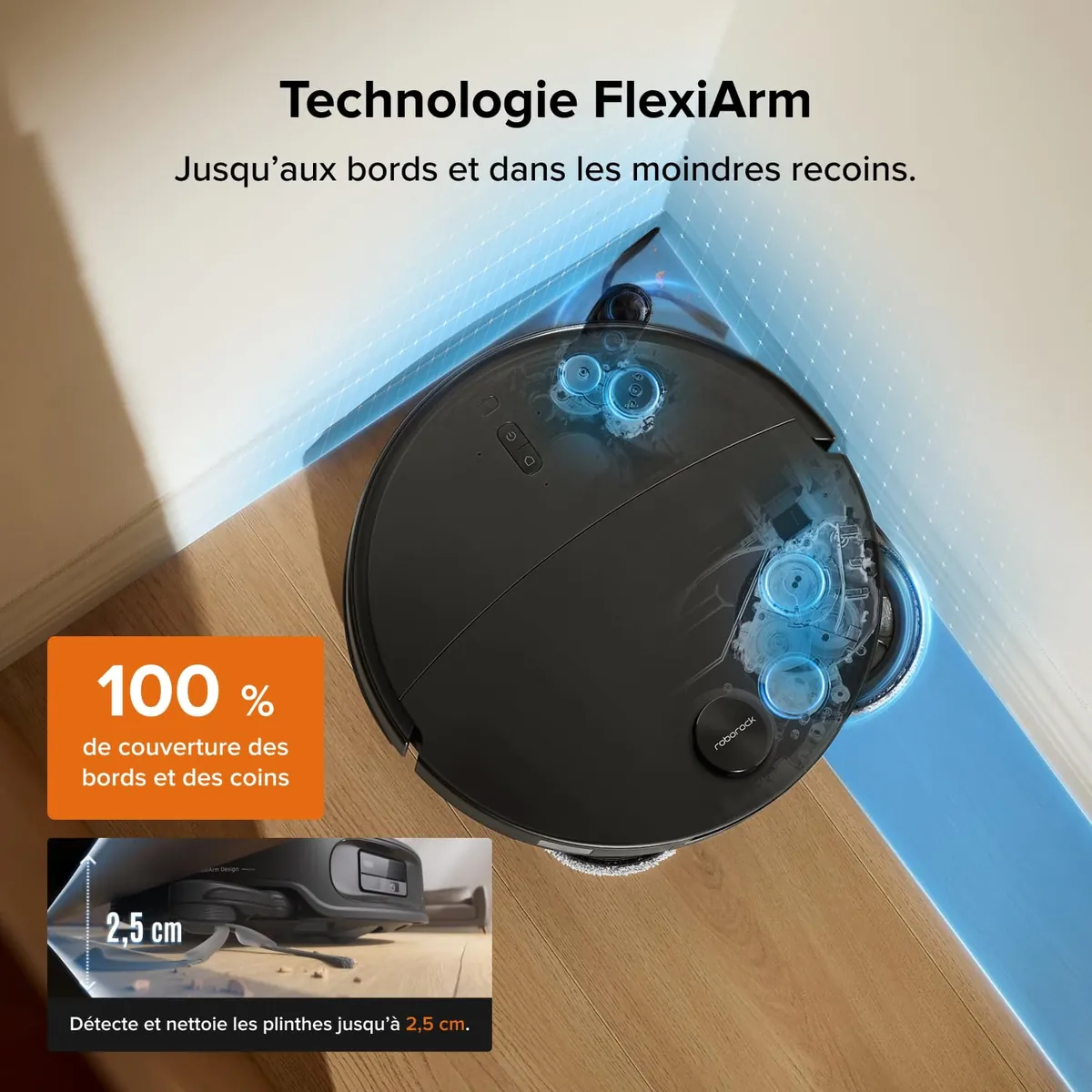
- FlexiArm
- RetractSense
- Reactive AI
- 80 °C wash
- 55 °C drying
- SmartPlan 3.0
Every edge, every corner.
The seven technologies of the Roborock Qrevo Edge 2. Select a feature to see it in a picture.
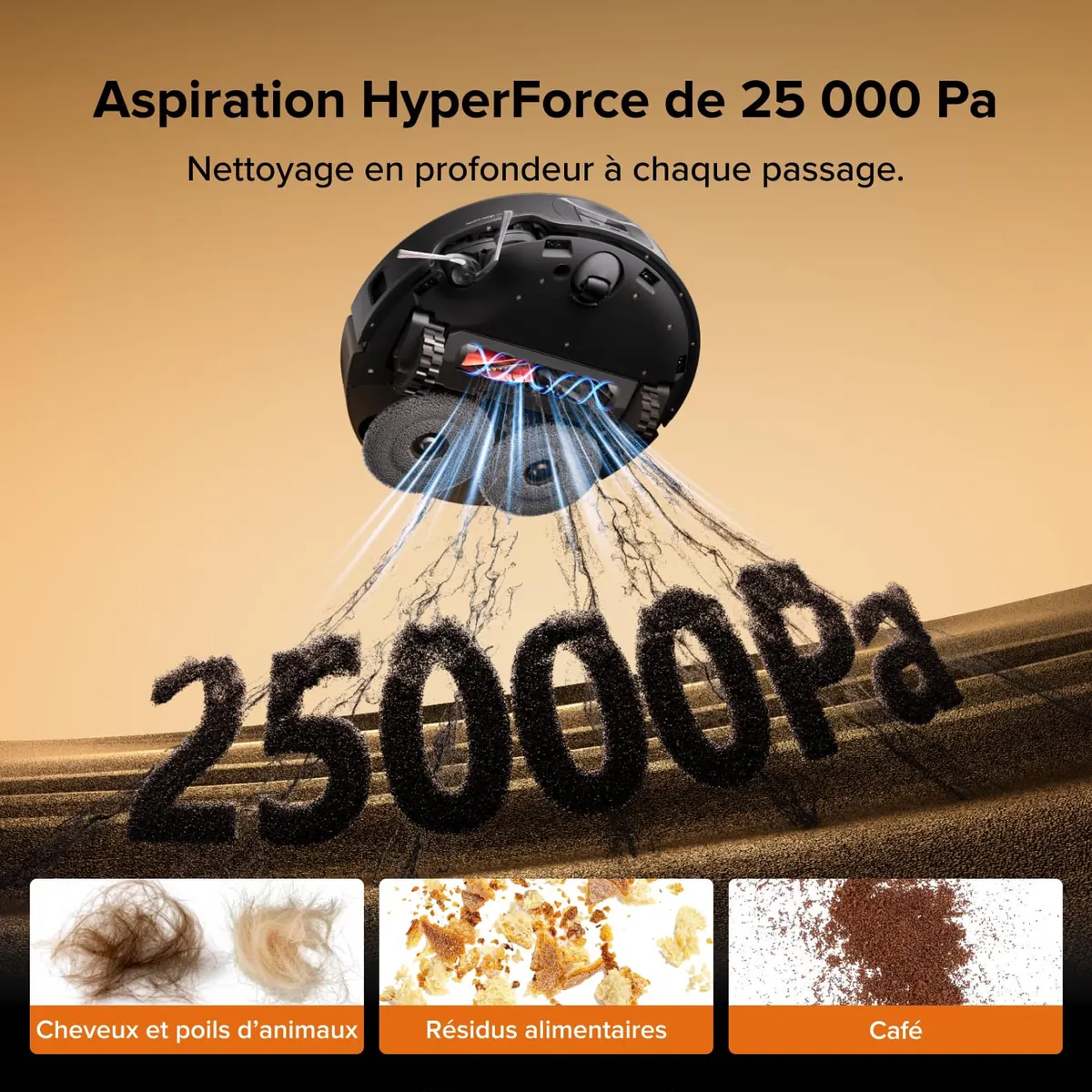

- 25,000 PaSuction claimed by Roborock
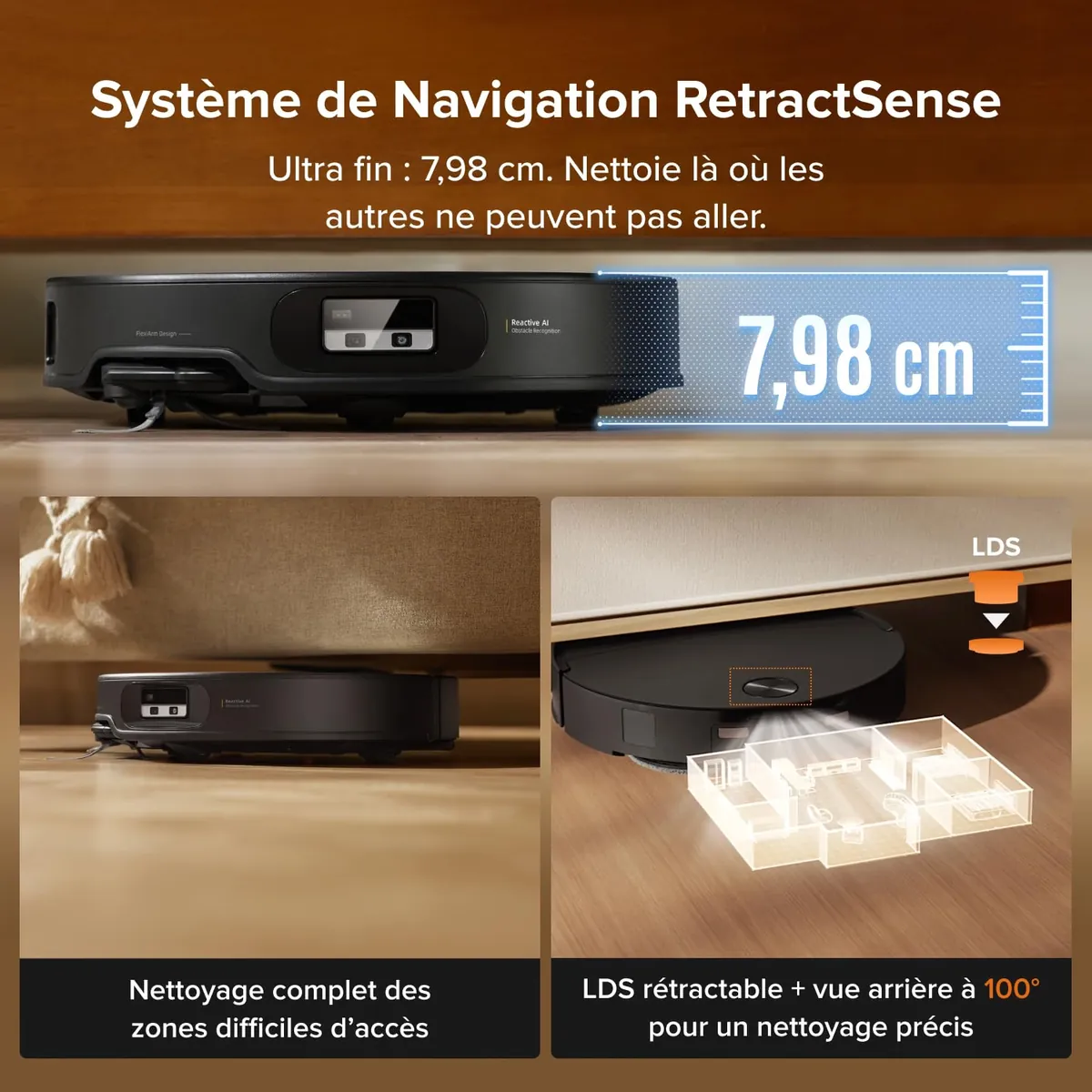
- 7.98 cmHeight, LiDAR retracted
- 280+Object types recognised
- 65 daysAutomatic emptying, at most
It takes care of everything.
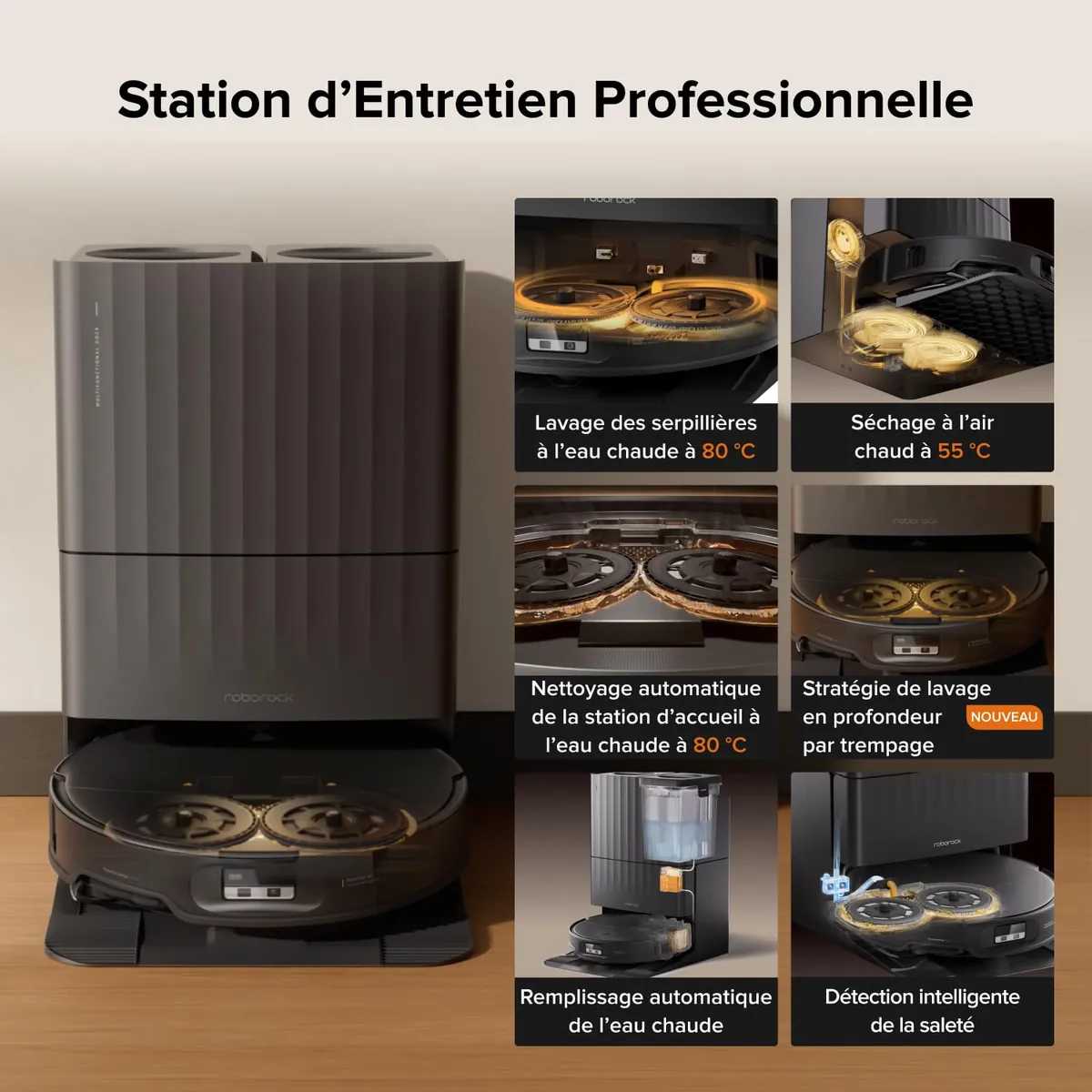
- 80 °CHot-water mop washing
- 55 °CWarm-air drying
- 65 daysAutomatic dust emptying, at most
- Warm waterAutomatic refilling of the robot
- SoakingNew mode for very dirty mops
- RemovableDetachable base for cleaning
Figures claimed by Roborock. 4 L clean-water and 3.5 L dirty-water tanks according to published tests. No automatic detergent tank: you add the cleaning product by hand. See our guide to docking stations.
Guide contents
The essentials in 30 seconds:
- A robot vacuum mop vacuums and then mops hard floors on its own, following a map of your home. Its dock recharges it and, on complete models, empties the dust, then washes and dries the mops.
- It does not replace everything: it does not climb stairs, does not clean the sofa or high skirting, and it needs a reasonably clear floor to work well.
- The criteria that matter: suction and brushes, mopping quality, the dock, navigation and obstacle avoidance, robot height, threshold climbing and running costs.
- Figures in pascals almost always come from manufacturers’ internal tests: they cannot be compared directly from one brand to another.
- Our reference model, the Roborock Qrevo Edge 2, is only 7.98 cm tall, pushes its brush and mop out towards the skirting boards, and relies on a dock that washes the mops at 80 °C and dries them at 55 °C according to Roborock.
Comparison: the right robot mop for your home
There is no single best robot vacuum mop in absolute terms; there is the best machine for your home, your floors and the way you live. A family with a dog, a large rug and a cluttered living room does not have the same needs as someone living alone in a tiled flat. This comparison ranks the main families of robots on the criteria that really change everyday life, then gives the best choice for each profile.
| Criterion | Roborock Qrevo Edge 2 | Entry-level robot mop | Mid-range robot mop | High-end roller robot |
|---|---|---|---|---|
| Mopping | 2 spinning mops, 8 N, 12 mm lift | Dragged pad, tank in the robot | Spinning mops or vibrating pad | Roller rinsed continuously |
| Dock | Emptying, 80 °C wash, 55 °C drying, refilling | Simple charging base | Emptying, sometimes washing | Complete dock, often with detergent |
| Height | 7.98 cm, retractable LiDAR | Often 9 to 10 cm | Often 9 to 10 cm | Varies |
| Navigation | LiDAR, RGB camera, structured light | Gyroscope or basic LiDAR | LiDAR | LiDAR and camera |
| Edges and corners | FlexiArm brush and extending mop | Fixed side brush | Sometimes an extending mop | Extending roller on some models |
| Typical weak point | Thresholds above 2 cm, no automatic detergent | Light mopping, manual upkeep | Dried-on stains | Price, size |
| Ideal for | Flats and houses with low furniture, pets, mixed floors | Small areas, light upkeep | Family homes without special constraints | Large hard floors mopped often |
This table shows trends: values vary from one model to another, and only specification sheets and independent tests can compare two robots in detail. To refine your choice, our calculator estimates your cleaning time and compares it with the claimed runtime.
What is a robot vacuum mop?
A robot vacuum mop is a self-driving appliance, round or D-shaped, that moves around the floor on its own to vacuum and mop it. It carries a battery, a suction motor, a main brush, one or more side brushes, a small dustbin, a water tank and a mopping system. A fixed base, called a station or dock, recharges it between sessions.
The first robots simply vacuumed while bumping into walls. Today’s models map the home with a laser, recognise rooms, avoid socks and cables with a camera, lift their mops when they reach a rug and return to the dock to wash their mops along the way. The most complete ones only need you to empty the dirty water and change the dust bag from time to time.
Its great advantage comes down to one word: regularity. A robot cleans every day, or every other day, without you having to think about it. Dust, hair and crumbs do not have time to build up or get ground in. That habit, more than raw power, is what changes how clean a home is.
It still has limits. It does not climb stairs, does not deal with sofas or curtains, can get stuck on a high threshold or a fringed rug, and needs a reasonably tidy floor. Nor does it replace vigorous scrubbing of dried-on stains. Knowing these limits before buying avoids disappointment and helps you choose a model suited to your real day-to-day life.
The vocabulary adds to the confusion. In shops you will find “robot vacuum”, “robot mop”, “robot vacuum and mop”, “2-in-1 robot” or “robot with all-in-one dock”. What matters is not the name, but what the mopping system really does and what the dock takes care of.
How a robot mop works
Five systems do the work, and each one counts in the result.
- Navigation locates the robot in space. A rotating laser rangefinder, the LiDAR, measures distances to walls and furniture and draws the map. A camera and structured light identify small objects on the floor. Cliff sensors keep it away from steps.
- Suction creates a pressure drop that draws dust and debris into the bin. It is expressed in pascals (Pa): Roborock claims 25,000 Pa for the Qrevo Edge 2, a figure from its internal tests.
- The brushes loosen the dirt. The main brush, under the robot, beats rug fibres and picks up debris; the side brush sweeps dust from the edges towards it.
- Mopping rubs the floor with a damp textile. Depending on the model, this is a dragged pad, a vibrating plate, two spinning mops or a roller.
- The dock recharges the battery and, depending on its level, sucks the contents of the bin into a bag, washes and dries the mops, and refills the robot’s water tank.
Everything is controlled through an app that shows the map and lets you name rooms, set no-go zones, adjust suction and water flow room by room and schedule cleaning sessions. Recent models also offer an automatic mode that chooses the strategy by itself: the Qrevo Edge 2 calls it SmartPlan 3.0.
Pads, spinning mops or roller
The mopping system makes the biggest difference between two robot mops. There are four main families.
| System | Principle | Strengths | Limits |
|---|---|---|---|
| Dragged pad | A damp textile fixed under the robot | Simple, inexpensive | Light mopping, the pad gets dirty quickly |
| Vibrating plate | The pad vibrates rapidly | Better scrubbing than a fixed pad | Edges poorly covered |
| Spinning mops | Two textile discs rotate while pressing on the floor | Good scrubbing, can lift, can extend to the edges | Dried-on stains often need several passes |
| Roller | A textile cylinder rinsed continuously | Always mopping with clean water | Newer, often more expensive and bulkier |
The Qrevo Edge 2 uses two spinning mops that turn at 200 rpm with 8 N of pressure according to Roborock. One of them can extend towards the skirting board. They lift by 12 mm when the robot reaches a rug and, on thick rugs, the robot can leave them at the dock before vacuuming, according to the Maniaques test. Our guide to wood floors, tiles and rugs explains how each system behaves on each floor.
Our pick: the Roborock Qrevo Edge 2
Among robot vacuum mops with a complete dock, we recommend the Roborock Qrevo Edge 2 to households that want a robot able to cover everything, including under low furniture and along skirting boards. It does not win every test: it only climbs modest thresholds and does not dose detergent by itself. Above all, it combines strengths rarely found together in its price range.
- A 7.98 cm profile. Its laser rangefinder, the LiDAR, retracts into the body of the robot before it goes under a bed or sofa; an upward-facing dToF sensor measures the clearance and a 100° rear view takes over.
- FlexiArm technology. The arc-shaped side brush and one mop extend towards walls and corners. Roborock states that it cleans under kitchen kickboards up to 2.5 cm deep.
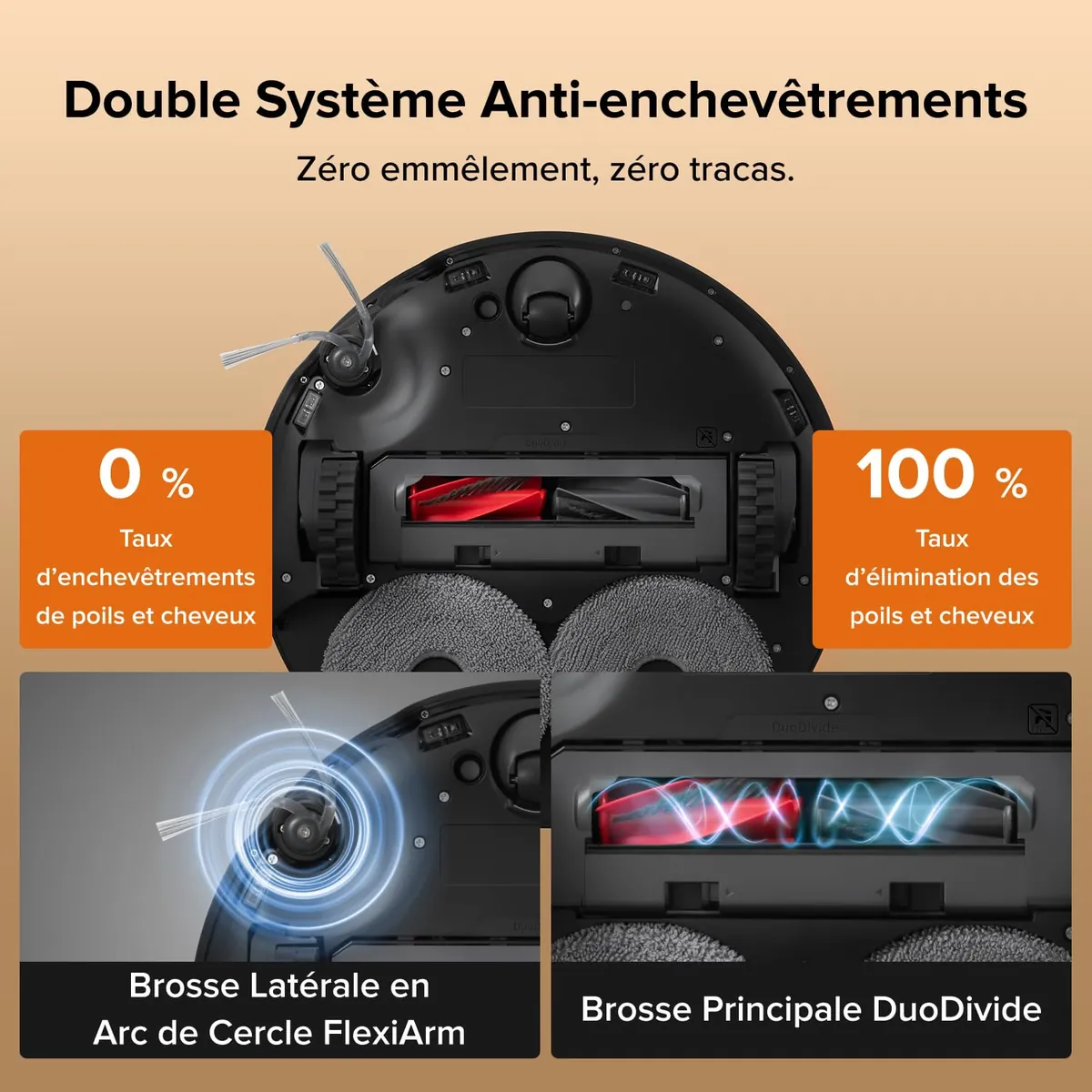
- 25,000 Pa of suction claimed by Roborock, with a two-part DuoDivide main brush that aims for 0% tangling, long hair included.
- A complete dock: mop washing in hot water up to 80 °C, warm-air drying at 55 °C, automatic dust emptying for up to 65 days, warm-water refilling and a detachable base.
- Reactive AI recognition of over 280 object types, day or night, thanks to structured light and an RGB camera.
Published tests confirm the essentials. The American lab Vacuum Wars measured 94% of sand removed from a carpet, compared with an average of 78% for the robots it has tested, and no hair wrapped around the brush. Maniaques cleaned more than 800 m² in total and highlights how well the FlexiArm works at the foot of skirting boards. The same tests point out its limits: threshold climbing of about 2 cm, room for improvement with thin cables and flat objects, and dried-on stains that need several passes. Our specifications page lists each value with its source.
The 10 criteria of a good robot mop
- Suction and brushes. High suction is not enough: the main brush must beat rugs and resist hair.
- The mopping system. Spinning mops or a roller, downward pressure, adjustable water flow and lifting on rugs.
- The dock. Emptying, hot-water mop washing, drying, automatic refilling: each function removes a chore.
- Navigation. A LiDAR for an accurate map, a camera to recognise objects, reliable cliff sensors.
- Height. Measure the space under your beds and sofas: a few millimetres decide whether the robot gets through.
- Threshold climbing. Check the height of your door sills and transition strips: beyond the stated capacity, the robot gets stuck.
- Edges and corners. An extending brush or mop reduces the strip of dust along the walls.
- Runtime and resume. The robot must cover your floor area or be able to recharge and then resume where it stopped.
- The app. Multi-floor maps, no-go zones, room-by-room settings, schedules and compatibility with your smart home.
- Running costs. Spare bags, filters, brushes and mops, availability of parts and repairability.
Our guide on how to choose a robot vacuum mop goes through each criterion, with benchmarks to remember and a checklist before you buy.
Pascals, newtons, degrees, minutes: reading the numbers
Robot mop specification sheets line up units that do not measure the same thing. Mixing them up leads to misleading comparisons.
| Figure | What it measures | What it does not tell you |
|---|---|---|
| Pascals (Pa) | The maximum pressure drop created by the motor | Airflow, brush efficiency, and the measurement method, which is specific to each brand |
| Newtons (N) | The force with which the mop presses on the floor | Textile quality, rotation speed, dampness |
| Degrees (°C) | The temperature of the wash water or drying air in the dock | Mopping of the floor itself, done with the tank’s warm water |
| Minutes of runtime | The maximum operating time, usually at the most economical setting | Runtime with strong suction and active mopping |
| Number of obstacles | The categories of objects learned by the artificial intelligence | The real avoidance rate, which varies a lot with the size and shape of objects |
| Days of emptying | The maximum time before changing the dock’s bag | The real duration, which depends on floor area, hair and frequency |
Roborock itself states, at the bottom of its product page, that the 25,000 Pa, the 0% tangling and the 65 days of emptying come from internal tests and that results may vary. That is a useful clarification: a manufacturer’s figure gives an order of magnitude, an independent test gives a measurement. Our article on suction, pascals and runtime explains these units in detail.
Be especially wary of the race for pascals. A robot rated at 30,000 Pa does not necessarily pick up more than another rated at 20,000 Pa: the shape of the brush, the airtightness of the air path and the cleaning speed matter as much as the maximum pressure drop. Independent tests that measure the sand or hair actually picked up from a carpet remain the best reference.
The dock: what it really does
The dock turns a robot that needs daily attention into an almost self-sufficient appliance. Not all docks are equal.
- Automatic emptying sucks the contents of the robot’s small bin into a bag. Roborock claims up to 65 days without intervention for the Qrevo Edge 2; retailer listings state a 2.7 L bag.
- Mop washing rinses the mops and scrubs them on a plate. With hot water, here up to 80 °C according to Roborock, it dissolves kitchen grease better.
- Drying with warm air, at 55 °C on this model, prevents smells and mould in the textiles.
- Automatic refilling tops up the robot’s small tank with warm water from the dock’s clean-water tank, 4 L according to published tests.
- Dirty-water collection, in a 3.5 L tank, which you empty by hand.
Two points are often forgotten before buying. The dock takes up space: 34 cm wide, 48.7 cm deep and 52.1 cm high according to Roborock, with clearance needed in front of it. And not every dock doses detergent: the Qrevo Edge 2’s has no dedicated tank, so you add the product by hand to the clean water. Our guide to the robot mop docking station reviews each function.
Navigation, mapping and obstacles
A robot that knows where it is cleans faster, misses fewer areas and gets stuck less. Three technologies are combined on today’s models.
- LiDAR, a rotating laser rangefinder, draws an accurate map in a few minutes. On the Qrevo Edge 2, it retracts to get under low furniture: this is the RetractSense system.
- The camera, combined with structured light, recognises objects: socks, cables, slippers, pet bowls, pet waste. Roborock claims over 280 object types and objects from 3 cm wide and high.
- Sensors for cliffs, contact and walls complete the system. PCWorld counts four cliff sensors on this model.
Tests put these promises into perspective. Vacuum Wars counted 14 obstacles avoided out of 24 for the Qrevo Edge 2, a lower score than its predecessor. PCWorld notes good results with bowls and toys, but difficulties with thin cables and very flat objects. Maniaques found that socks and a charger were avoided, but that a Lego brick and a small bottle were hit. The practical takeaway: a quick tidy of the floor is still useful before each session. Our article on navigation, mapping and obstacles explains how to prepare your home.
Wood floors, tiles, rugs: what the robot does
A robot mop adapts its behaviour to the floor, provided it is set up properly.
| Floor | What the robot does | Recommended setting | Watch out for |
|---|---|---|---|
| Lacquered wood, laminate | Vacuuming and mopping with little water | Low water flow | Oiled or waxed wood floors do not tolerate water well: check the flooring instructions |
| Tiles | Vacuuming and mopping, cross passes possible | Medium flow, deep mopping in the kitchen | Deep grout lines hold on to dirt |
| Vinyl, lino | Vacuuming and mopping | Low to medium flow | Few constraints |
| Low-pile rugs | Mops lifted by 12 mm, boosted suction | Automatic carpet boost | Avoid mopping on thin rugs if lifting is not enough |
| Thick rugs, carpet | Mops left at the dock, vacuuming only | Carpet mode in the app | Fringes and very long pile can trap the robot |
Our guide to robot mops on wood floors, tiles and rugs details the settings for each surface.
Pet hair and long hair
Pet hair and human hair cause a robot two problems: they wrap around the main brush and side brushes, which then lose efficiency, and they quickly fill the small bin. A good robot for a home with pets therefore needs tangle-free brushes, automatic emptying and reliable pet-waste recognition.
The Qrevo Edge 2 combines a two-part DuoDivide main brush and a FlexiArm side brush, rated by Roborock at 0% tangling with hair up to 40 cm long. Vacuum Wars found no hair wrapped around the brush and measured 89.5% of pet hair picked up from a carpet, above the average of its tests. The app adds a pet mode, photos and pet tracking with the camera. Our guide to robot mops and pet hair presents the settings that work.
During spring and autumn moulting, run more short sessions rather than one longer one: a daily pass over the areas where the animal sleeps is better than a big weekly clean.
Setting up and scheduling your robot
- Place the dock against a wall, on a hard, flat floor, near a socket, with free space in front and on the sides as stated in the manual.
- Connect the robot to the app over 2.4 GHz Wi-Fi: it is the only network the Qrevo Edge 2 supports.
- Start the mapping run with doors open and the floor clear. PCWorld reports about 70 m² mapped in under 5 minutes; Maniaques counted 12 minutes for 80 m².
- Check the rooms suggested, merge or split them, and name them.
- Draw no-go zones around pet bowls, cables and fringed rugs.
- Set up each room: suction, water flow, cleaning order, double pass in the kitchen.
- Schedule the sessions, ideally when nobody is at home.
- Fill and adjust: clean water in the dock and, if needed, a compatible detergent, dosed by hand.
Our user guide goes through each step with the Roborock Qrevo Edge 2.
Upkeep: what you still do by hand
Even with a complete dock, a robot mop needs a few regular tasks. Neglecting them reduces suction, damages the brushes and causes smells.
- Empty the dirty water and rinse its tank, ideally after each big mopping session.
- Fill the clean water and add detergent if you use any.
- Clean the filter: Maniaques recommends checking it every fortnight and notes that it clogs fairly quickly.
- Remove hair from the brushes and wheels, even with an anti-tangle system.
- Wipe the sensors and the camera with a dry cloth.
- Clean the base of the dock, which is detachable on this model, to prevent deposits.
- Change the bag, mops, filter and brushes when the app tells you to.
Our guide to robot vacuum mop maintenance gives the full schedule.
Mistakes to avoid
- Buying without measuring the height under your furniture and of your thresholds.
- Leaving cables and curtain cords on the floor for the first run.
- Mopping an oiled or waxed wood floor without checking that the flooring can take it.
- Pouring any product into the dock: only compatible detergents are suitable, dosed according to the manual.
- Forgetting the dirty water for several days: smells guaranteed.
- Installing the dock in a narrow nook or on a rug.
- Believing the robot does everything: stairs, sofas and dried-on stains still need a manual clean.
Safety and privacy
- Unplug the dock before taking it apart or cleaning it.
- Only use the cleaning products approved by the manufacturer: a foaming or corrosive product can damage the pumps.
- Do not let the robot run through a large puddle, a big liquid spill or pet waste: set up a no-go zone if needed.
- Keep the camera in mind: turn off remote video if you do not use it, keep the app up to date and protect your account with a strong password.
- Turn on the app’s child lock if young children can press the buttons.
Who it is for, and who it is not for
The Qrevo Edge 2 suits you if
- You have low beds and sofas where dust builds up underneath
- You want a robot that really deals with edges and corners
- You have a dog, a cat or long hair at home
- You want a dock that washes and dries the mops
- Your home has low thresholds and mostly hard or mixed floors
It does not suit you if
- Your door sills are higher than 2 cm
- You want automatic detergent dosing
- You are counting on the robot to scrub dried-on stains
- You have no room for a dock about 52 cm tall
- Your home is very small and your budget tight: a simpler robot is enough
Our detailed verdict looks at each of these profiles.
Buying on Amazon: what to check
The Qrevo Edge 2 comes in several versions and colours, and there are many sellers. Before ordering, check:
- The exact version: the Qrevo Edge 2, Edge 2 Set, Edge 2X, Edge 2 Pro and Edge 2 Flow do not all have the same mopping system or the same dock.
- What is in the box: the Set version includes spare accessories, and the exact contents may vary.
- The seller: Amazon or a third-party seller, and its return conditions.
- The guarantee: two years according to published tests, on top of your statutory rights.
- The price, which changes often: compare over a few days before buying.
In the UK, a distance purchase generally gives you a 14-day cancellation period under the Consumer Contracts Regulations, and the Consumer Rights Act protects you if the goods are faulty.
Check the price on AmazonRoborock Qrevo Edge 2 Set · new tabOur editorial method
We do not receive appliances from brands and we do not publish fake tests. Our guides are based on manufacturers’ specification sheets, on tests published by the specialist press and independent labs, and on an analysis of buyer reviews, summarised rather than copied. Figures are always quoted with their source. The site is funded by Amazon affiliate links, flagged as such, which do not change your price. More details on our affiliate disclosure page.
Frequently asked questions
What is the best robot vacuum mop?
It depends on your home. For a household that wants a robot able to get under low furniture, deal with the edges and look after itself almost entirely, we recommend the Roborock Qrevo Edge 2. For a small area with hard floors, a simpler robot is enough.
Does a robot mop replace the mop and bucket?
For everyday cleaning, yes. For dried-on stains and scrubbing, a manual clean is often still needed: tests of the Qrevo Edge 2 show that dried-on stains need several passes.
Does a robot mop damage wood floors?
On lacquered wood or laminate, with a low water flow, the risk is limited. Oiled or waxed wood floors do not cope well with moisture: check the flooring instructions and set the robot to vacuum only if needed.
How long does the battery last?
The Qrevo Edge 2 has a 5,200 mAh battery. Maniaques cleaned 80 m² by vacuuming then mopping with 18% battery left. The robot goes back to recharge on its own and resumes where it stopped.
Do you need a robot with a dock?
For a robot mop, a dock that washes the mops makes a real difference: without it, you have to wash the textiles by hand after every session. Automatic emptying is also very useful with pets.
Does the robot fit under the bed?
It depends on the clearance. The Qrevo Edge 2 is 7.98 cm tall with its LiDAR retracted: measure the space under your furniture and keep a few millimetres of margin.
Can you put detergent in the dock?
Yes, with a compatible product recommended by the manufacturer. The Qrevo Edge 2 has no dedicated tank: you add the product by hand to the clean water, at the stated dose.
Does the robot climb door thresholds?
Thresholds of about 2 cm, yes. Beyond that, the Qrevo Edge 2 can get stuck: PCWorld and Maniaques saw this with slightly higher obstacles. A small ramp can help.
Does the robot work on a 5 GHz Wi-Fi network?
No, the Qrevo Edge 2 only supports 2.4 GHz Wi-Fi. Most routers offer both bands: you just need 2.4 GHz to be switched on.
Is the robot noisy?
PCWorld measured 63 dB in balanced mode on the Qrevo Edge 2. The dock is louder for a few seconds while it empties the robot: schedule sessions for when you are out.
Do you need to tidy up before starting the robot?
A quick tidy is still useful: thin cables, cords and small flat objects are the obstacles robots avoid least well, even with a camera.
Is a robot mop suitable with pets?
Yes, as long as it has tangle-free brushes, automatic emptying and pet-waste recognition. Change the bag a little more often during moulting season.
How much does a robot mop cost to run?
Over time you will need bags for the dock, mops, filters and spare brushes. The Set version of the Qrevo Edge 2 already includes spare accessories.
Can you control the robot by voice?
Yes. The Qrevo Edge 2 has the Hello Rocky assistant, which works without Wi-Fi according to Roborock, and it is compatible with Matter, Alexa, Siri and Google Home.
Move your cursor. The robot vacuums.
Hover over the picture, or slide your finger across it: the disc follows your movement and gobbles up the crumbs. Just a visual demonstration: the real robot plans its routes from its map, it does not follow your finger.
Interactive illustration: the counter is a game, not a measurement. Real-world performance is covered in our review.
Every day, in your home.
What the Qrevo Edge 2 actually changes in looking after your floors.
Technical specifications.
- Suction25,000 Pa (HyperForce)
- Height7.98 cm, LiDAR retracted
- Robot35.2 × 35.2 cm, 4.5 kg
- Battery5,200 mAh
- Mopping2 spinning mops, 200 rpm, 8 N
- Mop lift12 mm
- Dock80 °C wash, 55 °C drying, auto-empty
- Dock tanks4 L clean, 3.5 L dirty
- Guarantee2 years
Roborock data (product page) cross-checked against published tests (Maniaques, PCWorld, Vacuum Wars). Details and sources in our full specifications.
Roborock Qrevo Edge 2
- Hard-floor pick-up★★★★★
- Carpet pick-up★★★★★
- Edges and corners★★★★★
- Mopping★★★★★
- Obstacle avoidance★★★★★
- Value for money★★★★★
The Roborock Qrevo Edge 2 is aimed at homes that want a robot able to work on its own from the floor to the underside of low furniture, with top-tier suction, a dock that does the upkeep and real work along the edges.
It is not for everyone: its threshold limits and the lack of automatic detergent dosing make it less relevant for a home with high door sills or for anyone who wants to scrub dried-on stains. Our detailed verdict explains who it is for, and who it is not for.
Why it is our top pick
- Only 7.98 cm tall: it cleans under beds and sofas that most robots cannot reach.
- The FlexiArm side brush and the extending mop deal with the strip of dust along the skirting boards.
- Top-tier carpet pick-up in published tests, and a DuoDivide brush that does not tangle.
- A complete dock: 80 °C washing, 55 °C drying, automatic emptying and warm-water refilling.
- Comfortable battery life: the 5,200 mAh battery covers a large home on one charge according to tests.
- Matter, a Hello Rocky voice assistant that works without Wi-Fi and a very complete app.
Limitations
- It climbs thresholds of about 2 cm: a higher door sill can stop the robot.
- No automatic detergent tank: you add the product by hand to the clean water.
- Dried-on stains often need several passes, as with most spinning-mop robots.
- Obstacle avoidance still struggles with thin cables and very flat objects according to several tests.
Our guides to go further.
Choosing, cleaning well, looking after your robot: each guide explores one topic in depth, with practical methods and sources.
Clean floors, without thinking about it.
25,000 Pa · 7.98 cm · 80 °C wash · 55 °C drying · over 280 object types recognised. The price changes often on Amazon: check it, along with the seller, the exact version (Set, X, Pro) and the accessories included, before you order.
Check the price on AmazonAffiliate link · new tab