Robot vacuum mops and pet hair: choosing and setting up well
Hair wrapped around the brushes, a full bin after one room, knocked-over bowls and accidents on the floor: a pet puts a robot to the test. Here is what it needs to cope, and the routine that saves time during moulting season.
Contents
Why pet hair is a special case
Pet hair does not behave like ordinary dust. It is long, light and often charged with static electricity. It clings to rug fibres, wraps around anything that spins and takes up a lot of volume for almost no weight. A robot that is very effective on crumbs can be disappointing when faced with a moulting shepherd dog or a long-haired cat.
With a pet, four difficulties add up:
- tangling: hair wraps around the main brush, the side brush and the wheels;
- volume: the robot’s small bin fills up after one or two rooms;
- obstacles: bowls, toys, beds and, sometimes, accidents on the floor;
- smells: hair and organic dirt in the bin, the bag and the mops.
Allergies are a further issue: it is not the hair itself that causes reactions, but proteins from the animal’s saliva, skin and glands, which settle on the hair and in fine dust. A daily pass limits how much builds up on the floor.
Finally, there is pet-specific debris: kibble scattered around the bowl, cat litter stuck to paws, strands of hay for rodents, soil brought in from the garden. A robot picks these up well if it cleans often and its main brush stays clear. For clumping litter granules, prevention is better: draw a no-go zone just in front of the litter tray.
The type of coat matters too. A short-haired cat sheds fine hairs that work their way into rugs; a long-haired dog sheds bulky tufts; a dog with a dense undercoat, such as a husky or a shepherd, sheds during moulting season an amount that surprises anyone who has never lived through it.
Brushes: the number one criterion
With a pet, the main brush decides everything. A brush that tangles loses its efficiency within a few days and forces you to cut hair out with scissors. Manufacturers have come up with several solutions:
- rubber brushes, which hair catches on less;
- built-in combs, which remove hair as it builds up;
- conical or split brushes, which slide hair towards a point where it is sucked up.
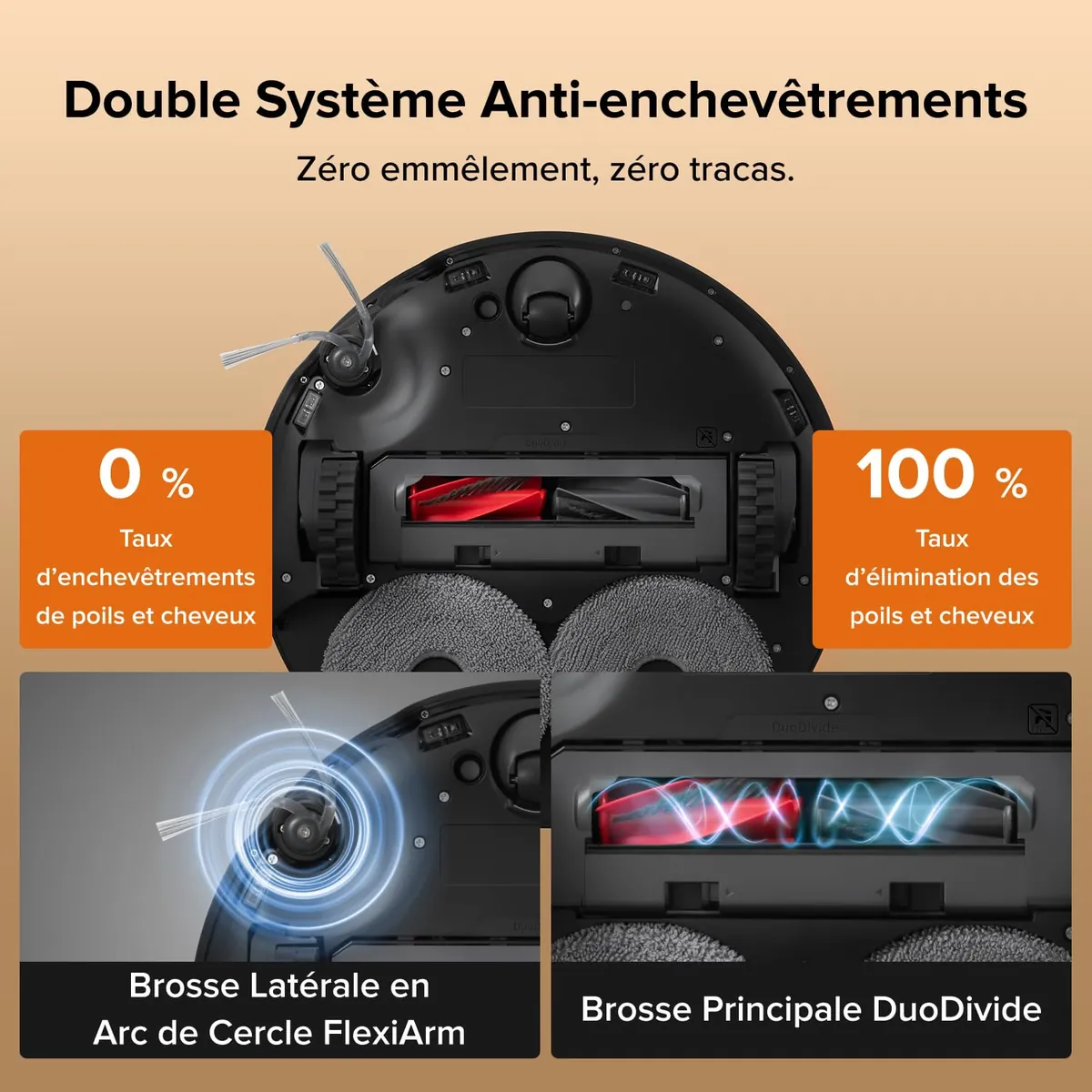
The Qrevo Edge 2 combines a DuoDivide main brush split in two in the middle and an arc-shaped FlexiArm side brush. Roborock claims 0% tangling for both, with hair up to 40 cm long for the main brush. Vacuum Wars found no wrapped hair with 18 cm hair, against an average of 26% for the robots in its tests, and Maniaques found the brushes still clean after several days of intensive cleaning.
Automatic emptying
Hair fills the robot’s bin very quickly, and it only holds 240 ml on the Qrevo Edge 2 according to PCWorld and Vacuum Wars. Without automatic emptying, you would have to empty it after every session, sometimes even midway. The dock solves the problem: it sucks the contents of the bin into a sealed bag, 2.7 L according to retailers.
Roborock claims up to 65 days without intervention, a maximum value. With a moulting dog, expect much less: watch for the app’s alert and change the bag as soon as it appears. The sealed bag has another advantage for people with allergies: you throw it away without handling the dust.
During a full clean, the robot can also go back to empty its bin midway if it fills up too fast. This is normal with a long-haired pet: an extra trip is better than a saturated bin that makes suction drop and leaves tufts behind.
Bowls, toys and accidents
A robot that pushes the water bowl around, swallows a toy or runs through an accident on the floor quickly becomes a nuisance. Camera-based object recognition is therefore valuable with a pet. The Qrevo Edge 2 combines structured light and an RGB camera to recognise more than 280 object types according to Roborock, and the app offers a dedicated pet mode.
Tests put these promises into perspective. PCWorld notes good results with bowls and dog toys, but difficulties with thin cables and very flat objects. Vacuum Wars counted 14 obstacles avoided out of 24. With a pet that is not yet house-trained or is unwell, be careful: draw a no-go zone around its litter tray and bed, and start the robot once you have checked the floor.

Mopping with a pet
Paws bring in mud, water spills from the bowl, drool marks dry on the tiles. A robot mop keeps these floors clean day to day, on a few conditions.
- Vacuum before mopping, or at the same time on a lightly soiled floor: mopping over hair turns it into damp clumps.
- Increase mopping around the bowls and the entrance, with a double pass if needed.
- Wash the mops often: the Qrevo Edge 2’s dock washes them in hot water up to 80 °C and dries them at 55 °C, which limits smells.
- Clean up accidents by hand before starting the robot.
Think about wet paws too. A dog coming back from a walk in the rain leaves muddy prints from the front door to its bed. A spot clean of the hallway, started with a tap in the app or by voice, sorts it out in a few minutes, without running the whole home again. An absorbent doormat, which the robot vacuums without mopping, catches a good part of the mud.
The settings that work
- Create a no-go zone around the bowls, the litter tray and toys that are often left lying around.
- Set stronger suction in the rooms where the pet sleeps and on rugs.
- Schedule a daily vacuuming pass in the living areas, plus mopping two to three times a week.
- Turn on pet mode if the robot offers one.
- Choose the timing: a pet can be stressed by the robot; at first, start it when the pet is out or in another room.
- Keep an eye on the bag in the dock thanks to the app’s alerts.
If your pet sleeps in a fixed spot, on a rug or a floor cushion, set that area up separately: maximum suction, no mopping, and one more pass than the rest of the home. The robot will then deal with the dirtiest spot without wasting its battery on little-used rooms.
The cleaning routine
With a pet, regularity matters more than intensity. A short, frequent pass stops hair from working its way into the fibres and spreading everywhere.
- Every day: vacuum the living areas, the hallway and the sleeping areas.
- Two to three times a week: mop the hard floors, focusing on the area around the bowls.
- Every week: check the brushes and wheels, and go over the sofa and the pet bed with a handheld vacuum.
- When alerted: change the bag, clean the filter.
Think about the route: start with the rooms where the pet spends least time and finish with those where it sleeps and eats, so as not to spread hair into rooms that are already clean.
Coping with moulting season
Many dogs and cats shed more hair in spring and autumn. During those weeks, the amount can multiply. A few measures lighten the load:
- brush your pet every day, preferably outdoors: every hair removed by the brush is one less on the floor;
- increase how often the robot runs rather than how long;
- wash throws, covers and pet beds more often;
- keep an eye on the bag and clean the filter more often.
Keeping the robot hair-free
Even with tangle-free brushes, hair ends up lodged in nooks and crannies. Regular upkeep prevents loss of suction and bad smells.
- Every week: turn the robot over and remove hair around the wheels, the front caster and the ends of the brush.
- Every two weeks: clean the filter, which Maniaques recommends checking every fortnight on this model.
- Every month: take out the main brush and clean its end caps; rinse the dock’s base.
- If there is a smell: empty and rinse the dirty-water tank, clean the base and let it dry.
Our guide to robot mop maintenance details each task.
Helping robot and pet get along
Most pets get used to the robot quickly, but the first few days count. Let your pet discover the appliance while it is switched off, then run it in another room while the pet is there, at a low suction level. Some cats end up ignoring it, others follow it with curiosity; a nervous dog will prefer it to run during its walk.
A few adjustments make life easier: a bowl mat that is easy to avoid, a litter tray placed in a box with a rim, toys put away in a basket in the evening. As for textiles, a washable throw on your pet’s favourite spot on the sofa limits the hair that later falls on the floor.
The Qrevo Edge 2’s app also offers pet-related features: photos, pet tracking and video calls from the camera. Useful for keeping an eye on your pet, they raise privacy questions: turn them off if you do not use them.
Rabbits, rodents and birds
Small pets bring their own debris: hay, wood shavings, seed husks and feathers that spread a long way around the cage. A robot picks these up well on hard floors if it passes every day, but long strands of hay can wrap around the side brush and the wheels: check them more often than with a cat.
A free-roaming rabbit is a special case. It may chew cables and be frightened by the robot, and its droppings are small and hard: draw a no-go zone around its area or run the robot only when the rabbit is in its pen. For birds, keep the robot away from the floor under the cage while the bird is out of it, and vacuum the seed husks once it is back inside.
What the robot does not do
A robot does not clean the sofa, the pet bed, car seats or stairs. For these surfaces, a handheld vacuum or a stick vacuum with a mini motorised tool is still needed. Our comparison of robot mops, stick vacuums and cylinder vacuums explains how to combine them. To choose the right settings for each floor, also read our guide to wood floors, tiles and rugs.
The Qrevo Edge 2 and pet hair
- a DuoDivide main brush and a FlexiArm side brush rated at 0% tangling;
- 89.5% of pet hair picked up from carpet by Vacuum Wars, above average;
- automatic emptying into a sealed bag;
- a camera and a pet mode to recognise bowls and toys;
- a dock that washes the mops in hot water and dries them.
Its limits remain: a 240 ml bin that makes the robot go back to empty itself more often during moulting season, and avoidance that could be better with some small objects. Our full review and our verdict go into these points.
Frequently asked questions
Which robot should you choose with a dog that sheds a lot?
A model with tangle-free brushes, automatic emptying and good carpet suction. Schedule a daily pass during moulting season.
Does the robot avoid pet waste?
Camera-equipped robots are designed to recognise many objects on the floor, but none guarantees perfect avoidance. With a pet that is not yet house-trained, check the floor before starting the robot.
Do you need automatic emptying with a cat?
It is strongly recommended: hair quickly fills the robot’s small bin, and the dock’s sealed bag saves you from handling the dust.
Are pets scared of the robot?
Some are wary at first. Run it in quiet mode, in another room, then while your pet is out until it gets used to it.
How often should you change the dock’s bag with a pet?
More often than the maximum claimed duration: follow the app’s alert, especially during moulting season.
Does the robot clean the dog’s bed?
No. For textiles, use a handheld vacuum with a mini motorised tool.
Does mopping spread pet hair around?
On a very hairy floor, yes. Vacuum first, then mop, or use the vacuum-then-mop mode.
Does a robot help with pet allergies?
It limits the build-up of hair and dust on the floor thanks to its daily passes. It does not replace airing the home or washing textiles.
Does pet hair clog the mops?
A little, especially if the robot mops before vacuuming. The dock washes the mops in hot water and dries them; during moulting season, also rinse the dock’s base more often to prevent deposits.
Can the robot get under the sofa or bed where the cat sleeps?
If there is enough height, yes: the Qrevo Edge 2 is only 7.98 cm tall with its LiDAR retracted. That is often where hair builds up, out of sight.
Does the robot pick up spilled kibble?
Yes, dry kibble is picked up like any other debris. Avoid running the robot through wet food or a spilled water bowl: clean those up by hand first.
Clean floors, without thinking about it.
25,000 Pa · 7.98 cm · 80 °C wash · 55 °C drying · over 280 object types recognised. The price changes often on Amazon: check it, along with the seller, the exact version (Set, X, Pro) and the accessories included, before you order.
Check the price on AmazonAffiliate link · new tab