Robot mop, stick vacuum or cylinder vacuum: which should you choose?
The robot mop promises clean floors without lifting a finger, the stick vacuum speed, the cylinder vacuum power, the wet-dry floor cleaner a real wash. Each has its strengths and limits. Here is a criterion-by-criterion comparison to find out which suits you, or which combination.
Contents
Four ways to look after your floors
Choosing between a robot mop, a stick vacuum, a cylinder vacuum or a wet-dry floor cleaner is not just choosing an appliance. It is choosing a way of doing the housework.
- The robot vacuum mop moves around on its own according to a schedule, vacuums and then mops hard floors, and returns to its dock to recharge and, on complete models, to empty itself and wash its mops. It is the appliance for effortless daily upkeep.
- The cordless stick vacuum combines motor, bin and battery in an appliance held in one hand. It comes off the wall in two seconds and often converts into a handheld vacuum. It is the appliance for quick passes and nooks.
- The cylinder vacuum is the classic vacuum cleaner, on wheels and plugged into the mains. It is the appliance for big weekly sessions and thick carpets.
- The wet-dry floor cleaner, or manual vacuum mop, vacuums and mops at the same time with a damp roller. It is the appliance for a real wash of hard floors, guided by hand.
The right answer depends on your home, your floors, your time and your standards. Very often it involves combining two appliances. Let us look at each criterion.
The comparison in one table
| Criterion | Robot mop | Stick vacuum | Cylinder vacuum | Wet-dry floor cleaner |
|---|---|---|---|---|
| Hard-floor pick-up | Very good for upkeep | Very good | Very good | Good |
| Thick-carpet pick-up | Good to average | Good to very good | Very good | Unsuitable |
| Mopping | Everyday upkeep | None (except mopping models) | None | Very good |
| Effort | None during cleaning | Low | Medium | Medium |
| Stairs, sofa, height | Impossible | Very good (handheld mode) | Good (hose) | Impossible |
| Under low furniture | Very good if the robot is slim | Good | Average | Average |
| Upkeep of the appliance | Reduced with a complete dock | Bin and filter | Bags and filters | Dirty-water tank after each use |
| Space | Dock on the floor | Wall mount | Cupboard | Charging base |
This table shows trends. The differences between models in the same family are sometimes greater than between families: an entry-level robot does not clean like a robot with a complete dock.
Cleaning performance
The cylinder vacuum, the long-standing benchmark
Plugged into the mains, a cylinder vacuum has no battery constraint. It can run a powerful motor for as long as needed, with a wide floor head. On thick carpet, a good cylinder vacuum with a turbo brush remains a benchmark for deep dust extraction.
The stick vacuum, fast and versatile
High-end stick vacuums have closed much of the gap. Their motorised heads reach dust deep in the fibres, and their maximum power rivals that of a cylinder vacuum for a few minutes. Their real strength lies elsewhere: people get them out more often.
Their limit is the battery: maximum power only lasts a few minutes, and a large area of carpet sometimes calls for a second battery or two sessions. On hard floors and low-pile rugs, a good stick vacuum does as well as a cylinder, in much less time.
The robot, champion of regularity
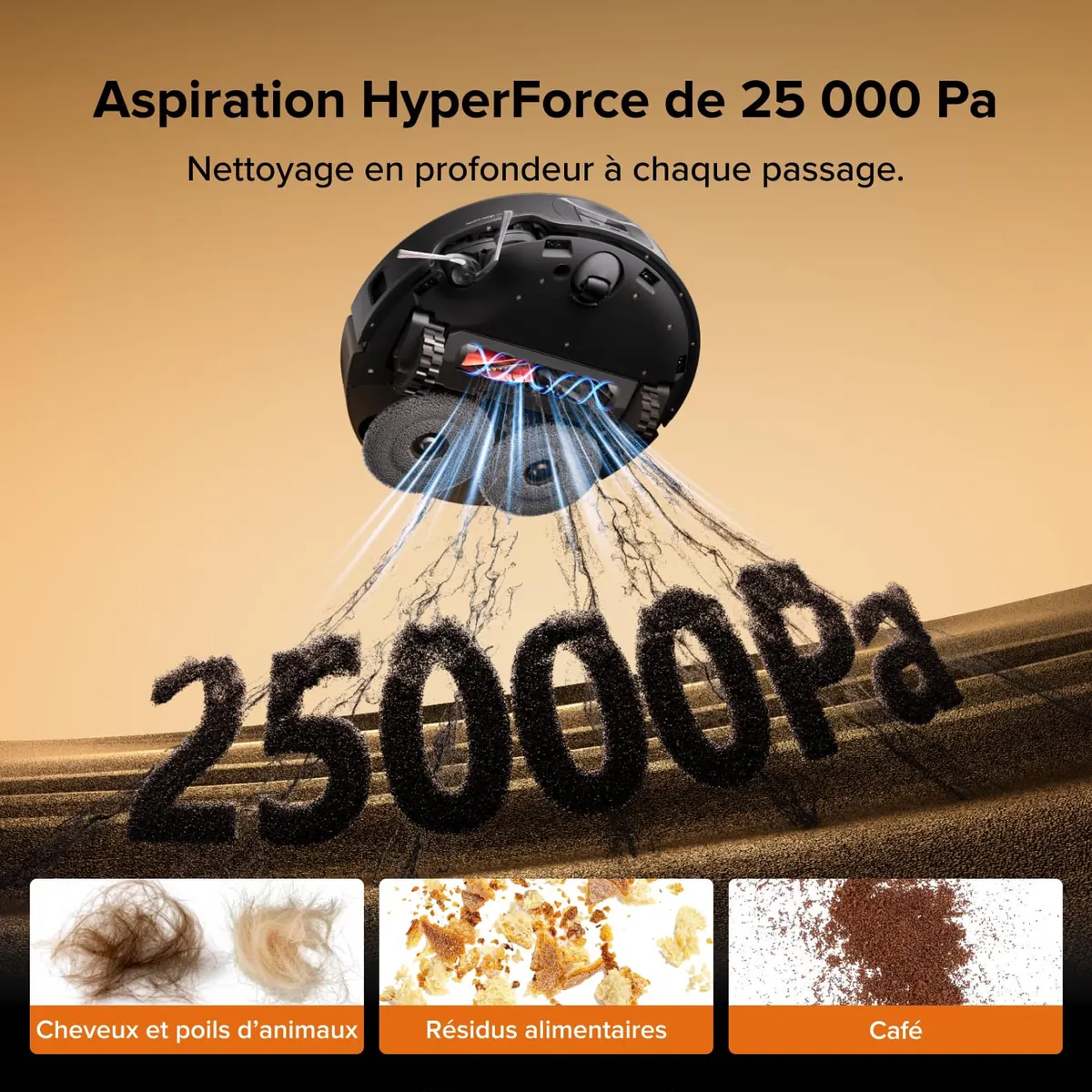
A robot vacuums less strongly per square metre than a stick or cylinder vacuum, because everything has to fit into a housing a few centimetres high. It makes up for it with frequency: it cleans every day, and dust does not have time to get ground in. The best robots still achieve remarkable measurements: Vacuum Wars recorded 94% of sand removed from a carpet by the Qrevo Edge 2, against an average of 78% for the robots in its tests.
In short: on pure power, the cylinder and the high-end stick vacuum keep the edge for deep cleaning. The robot wins through regularity, and regularity often does more for cleanliness than the power of one weekly session.
Mopping
This is where the families differ most. The cylinder vacuum and most stick vacuums do not mop. The robot mop and the wet-dry floor cleaner do, in very different ways.
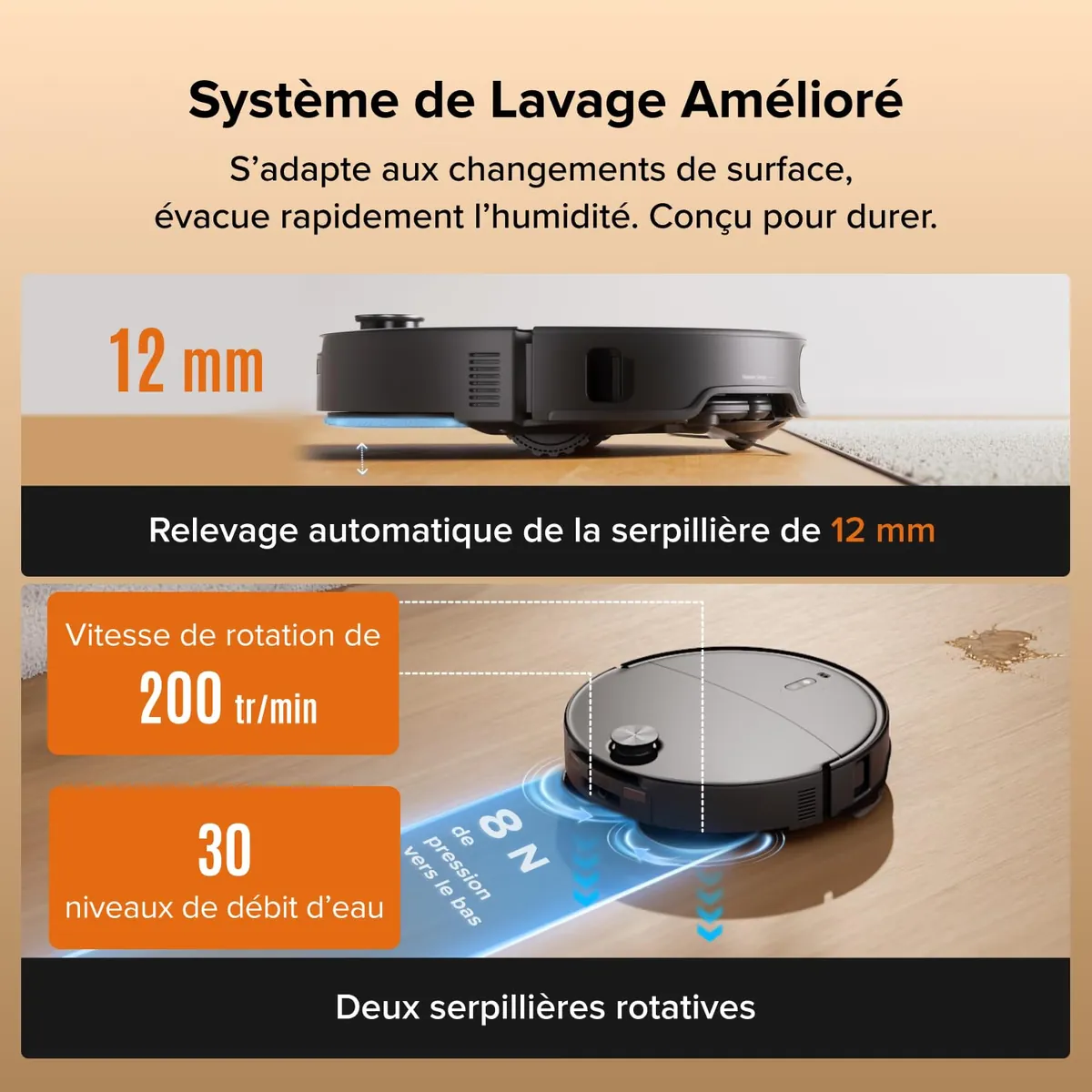
- The robot mop maintains: it passes often with little water, scrubs with its mops and leaves a floor clean day to day. The Qrevo Edge 2 uses two spinning mops at 200 rpm with 8 N of pressure according to Roborock. On dried-on stains, several passes are often needed, as PCWorld and Maniaques found.
- The wet-dry floor cleaner washes deeply: a damp roller, rinsed continuously, scrubs the floor while the appliance sucks up the dirty water. It gets rid of stubborn stains, but you have to guide it yourself and rinse its tank after each use.
- The mopping stick vacuum, a hybrid between a stick vacuum and a floor cleaner, vacuums and dampens in a single pass; it suits small hard floors, less so rugs.
- The traditional mop is still useful for occasional scrubbing of a very dirty kitchen or hallway.
For most households, the robot is enough for everyday upkeep of hard floors; the wet-dry floor cleaner or the mop takes over a few times a month for a deep wash.
The time you spend
This is the robot’s decisive argument. Once the map is made and the schedule set, it cleans while you are at work. With a complete dock, your involvement is limited to emptying the dirty water, filling the clean water, changing the bag from time to time and removing hair from the wheels.
A stick vacuum takes a few minutes each time, but it is easy to grab. A cylinder vacuum means getting it out of the cupboard, unwinding the cable, changing sockets and putting everything away: so people keep it for the big weekly session. The wet-dry floor cleaner needs filling, guiding and then rinsing.
Count the preparation too: a robot needs a clear floor. Tidying away shoes, cables and toys takes a few minutes, which soon becomes a habit.
To give an idea, a 70 m² flat takes about twenty minutes with a stick vacuum and a little longer with a cylinder, including getting it out and putting it away. The robot will spend more time on it, around an hour of vacuuming and mopping according to our estimates, but that time costs you nothing: it works on its own while you are out. Our calculator estimates this time for your home.
Nooks, height and stairs
The convertible stick vacuum wins clearly: remove the wand and it becomes a handheld vacuum that goes everywhere, stairs, sofa, car, shelves, cobwebs. The cylinder vacuum can do the same thanks to its hose, by carrying it up the stairs.
The robot does not climb stairs and cleans nothing above the floor. It has one asset the others lack: it goes under low beds and sofas on its own, provided it is slim enough. The Qrevo Edge 2 is only 7.98 cm tall with its LiDAR retracted, and its FlexiArm brush reaches for the dust along skirting boards, up to 2.5 cm underneath according to Roborock.
Floor by floor
Tiles, vinyl, lacquered wood
The robot mop is in its element: vacuuming and light mopping every day, with little water. Stick and cylinder vacuums pick up very well; the wet-dry floor cleaner washes deeply.
Oiled or waxed wood
These finishes do not cope well with repeated moisture. Set the robot to vacuum only or to minimum water flow, after checking the flooring instructions. Stick and cylinder vacuums with a soft brush remain risk-free.
Low-pile rugs
The robot vacuums and lifts its mops, by 12 mm on the Qrevo Edge 2. A stick vacuum with a motorised head and a cylinder with a turbo brush are more effective for deep cleaning.
Thick rugs and carpet
The cylinder vacuum remains the benchmark, with the high-end stick vacuum close behind. The robot keeps them tidy but can struggle with very long pile or fringes. Our guide to robot mops on wood floors, tiles and rugs details the settings.
With pets
A pet makes the case for a robot: a daily pass stops hair from building up, especially during moulting season. You need a robot with tangle-free brushes and automatic emptying, such as the Qrevo Edge 2, whose DuoDivide brush wrapped no hair at all in the Vacuum Wars test.
The robot is not enough on its own, though: the sofa, the pet bed and car seats need a handheld vacuum or a stick vacuum with a mini motorised tool. Our guide to robot mops and pet hair presents a suitable routine.
The cylinder vacuum still has a role with a big long-haired dog and lots of carpet: its large bag capacity and continuous power deal with a moult in one session. The wet-dry floor cleaner is valuable around bowls and in the hallway, where paw prints and spilled water dry quickly.
Filtration and allergies
For people with allergies, two things matter: limiting dust on the floor and avoiding stirring it back into the air when emptying.
- A robot with a dock cleans often, which limits build-up, and empties its bin into a sealed bag. It vacuums while you are out, which reduces exposure.
- A bagged cylinder vacuum locks the dust inside the bag, which you throw away without contact.
- A stick vacuum often filters very well, but its bin is emptied by hand, which can release a cloud of dust.
In every case, filter upkeep determines how well it works. The Qrevo Edge 2’s filter is E11 class according to PCWorld; Maniaques recommends checking it every fortnight.
Noise
A robot is generally quieter than a cylinder or stick vacuum while it works, but it runs for longer. PCWorld measured 63 dB in balanced mode for the Qrevo Edge 2. The dock is louder for the few seconds it takes to empty the robot. Scheduling the robot while you are out solves the issue. Stick and cylinder vacuums are louder, but for short sessions.
In a flat, think of the neighbours: a robot running in the middle of the day disturbs less than a vacuum cleaner used late in the evening, and the app’s Do Not Disturb mode blocks sessions at the times you choose. The wet-dry floor cleaner, with its pumps and suction motor, is often the loudest of the four while in use.
Upkeep
| Appliance | Routine upkeep | Periodic upkeep |
|---|---|---|
| Robot mop with a dock | Empty the dirty water, fill the clean water | Bag, filter, brushes, wheels, dock base |
| Stick vacuum | Empty the bin after each session | Wash the filter, untangle the brushes |
| Cylinder vacuum | Change the bag when it is full | Filters, floor head |
| Wet-dry floor cleaner | Empty and rinse the dirty-water tank after each use | Roller, filter |
A robot without a dock is the most demanding: you have to empty its bin and wash its mop after almost every session. A complete dock reverses the trend. Our guide to robot mop maintenance details each task.
Storage and space
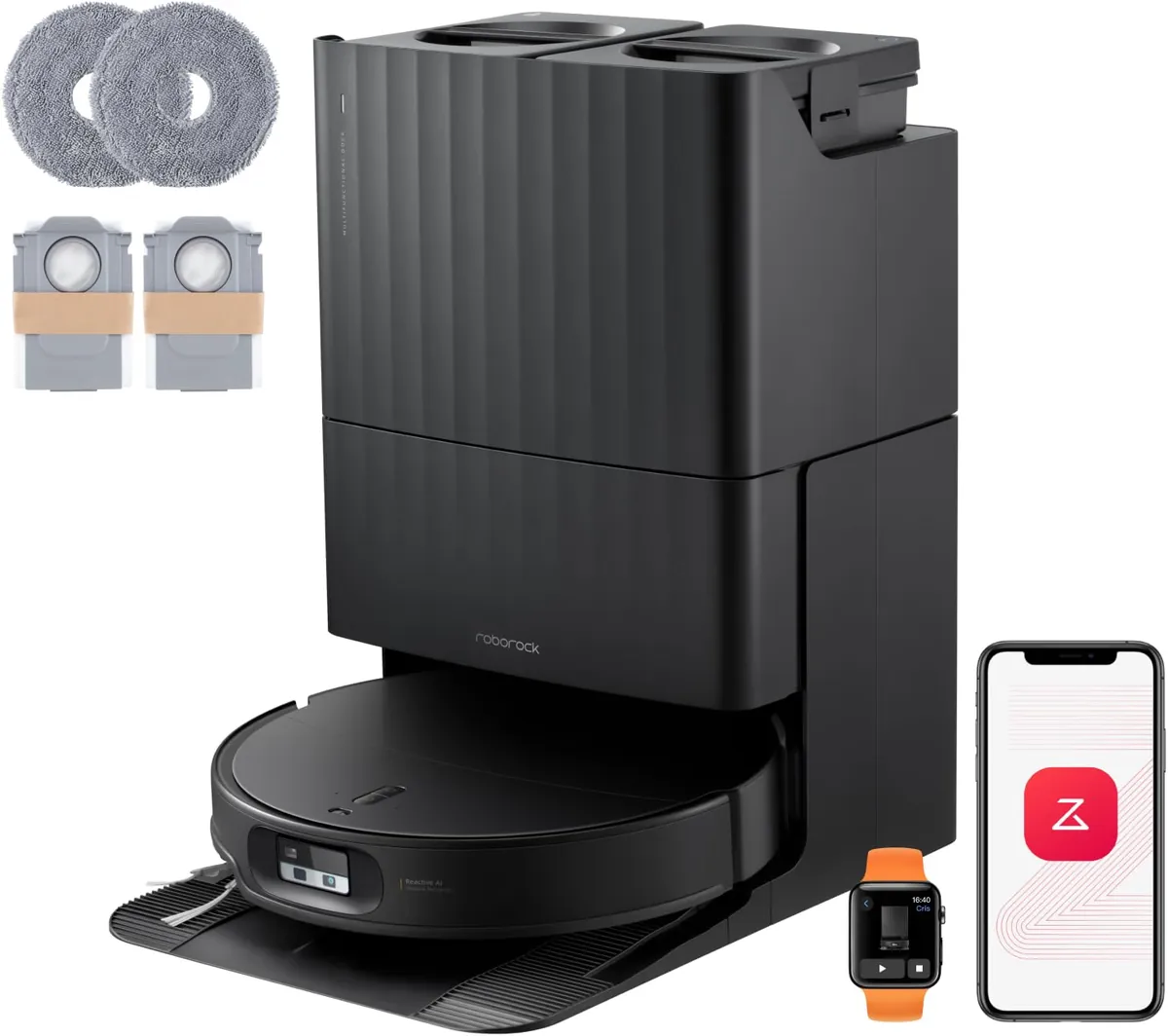
The robot lives in plain sight, on its dock on the floor against a wall. The Qrevo Edge 2’s dock is 34 cm wide, 48.7 cm deep and 52.1 cm high according to Roborock, with clearance needed in front. A stick vacuum hangs on the wall on a compact mount. A cylinder vacuum goes in a cupboard with its wand and tools. A wet-dry floor cleaner recharges on a base on the floor.
Before buying a robot, check that the spot planned for the dock is accessible: you need to be able to lift the tanks out from the top and leave the robot a clear path in front of the base. A nook under a low worktop can stop you opening the lid, and a sloping floor makes docking harder.
Running costs
Beyond the purchase price, each appliance has its consumables:
- the robot mop: dock bags, mops, filters, side and main brushes, and eventually the battery;
- the stick vacuum: few consumables, but a battery to replace after a few years depending on use;
- the cylinder vacuum: bags for bagged models, filters from time to time;
- the wet-dry floor cleaner: rollers, filters and possibly a dedicated detergent.
The robot is often the appliance that costs the most to run. The Set version of the Qrevo Edge 2 already includes spare accessories, which delays the first purchases.
Electricity accounts for little in the budget of these appliances. The robot uses more than a stick vacuum over a week, since it runs every day and its dock heats water and air to wash and dry the mops, but this remains modest compared with the cost of consumables.
Lifespan
A simple, sturdy cylinder vacuum can last for many years: little electronics, no battery. A stick vacuum depends on its battery and its motorised head. A robot combines the largest number of components: wheel motors, sensors, camera, LiDAR, dock pumps, battery. Its lifespan depends a lot on the availability of parts and the quality of after-sales service. Retailers display a French repairability index of 8.8 out of 10 for the Qrevo Edge 2X variant.
Whatever the appliance, upkeep makes the difference. A clean filter, untangled brushes and a battery stored at room temperature extend the life of a stick vacuum as much as a robot. Keep the receipt, register the appliance with the manufacturer and note the purchase date of replaced parts.
The right choice for your home
| Your situation | Our recommendation |
|---|---|
| Studio or small flat | A stick vacuum, or a simple robot if you want to delegate |
| Family flat, mixed floors | A robot mop with a dock, plus a small handheld vacuum |
| House with low furniture | A slim robot with a retractable LiDAR, plus a stick vacuum |
| Dog or cat | A robot with tangle-free brushes and auto-empty, plus a stick vacuum for upholstery |
| Large house with carpets | A cylinder or high-end stick vacuum, and a robot for daily upkeep |
| Large tiled areas mopped often | A robot mop, backed up by a wet-dry floor cleaner |
| Person with allergies | A robot with a bagged dock, or a bagged cylinder vacuum |
| Several floors | One robot per floor, or a robot carried between floors, plus a stick vacuum for the stairs |
To refine your choice of robot, see our guide on how to choose a robot vacuum mop.
Combining two appliances
For most households, the best solution is not one appliance but two. Three combinations work particularly well.
Robot mop and stick vacuum
This is the most common combination. The robot looks after the clear floors every day, vacuuming and mopping. The stick vacuum handles the stairs, the sofa, the car, the nooks and the small everyday spills. Each does what it does best, and the stick vacuum is only used for a few minutes a week.
This pairing also spreads the wear: the robot does the repetitive work, which spares the stick vacuum’s battery and motor for the tasks only it can do.
Robot mop and wet-dry floor cleaner
For large hard floors, an open-plan kitchen, a tiled hallway or a living area, the robot maintains them day to day and the wet-dry floor cleaner gives them a real deep wash once or twice a month.
Cylinder vacuum and robot
For large houses with lots of carpet, the cylinder handles the weekly deep session, and the robot keeps the floors clean between sessions.
Splitting the budget between two appliances
If you plan to combine a robot with a second appliance, think about the budget as a whole rather than appliance by appliance. The robot does most of the work, every day, so it deserves the larger share: a good dock, reliable navigation and tangle-free brushes are what you will notice week after week.
The second appliance can often be more modest. A mid-range stick vacuum or even a simple handheld vacuum is enough for the stairs, the sofa and the car, since it only comes out for a few minutes at a time. Conversely, if you have a lot of thick carpet, a good cylinder or high-end stick vacuum is the priority, and a simpler robot can handle the hard floors in between.
Finally, keep part of the budget for consumables: spare bags, mops, filters and brushes for the robot, and possibly a second battery for the stick vacuum. Planning for them from the start avoids leaving an appliance idle while you wait for a part.
Common misconceptions
- “A robot does all the housework.” It looks after clear floors very well, but does not do stairs or the sofa, and is poor at scrubbing dried-on stains.
- “A robot does not have enough suction.” That was true of the first models. Current robots achieve excellent measurements on carpet, and their daily pass makes up for the power of one weekly session.
- “A robot’s mopping is useless.” It keeps hard floors clean day to day; it does not replace occasional scrubbing.
- “The cylinder vacuum is outdated.” It is still the most enduring on large areas of carpet and the simplest to maintain.
- “The more expensive, the better.” A complete dock in a tiled studio with no pets adds little compared with a simpler robot.
Five questions to help you decide
- How much time do you want to spend on your floors? If the answer is “as little as possible”, the robot is the obvious choice.
- Is your floor clear? A robot needs a reasonably tidy floor; in a very cluttered interior, it will be less useful.
- Do you have stairs or a lot of upholstery? A convertible stick vacuum then becomes essential as a complement.
- Are your floors mostly hard or covered? Hard floors: robot mop and possibly a wet-dry floor cleaner. Thick carpets: cylinder or high-end stick vacuum.
- How much space do you have? A wall and a socket for the robot’s dock, a mount for the stick vacuum, a cupboard for the cylinder.
Your answers usually point to one main appliance and, often, a second as a complement. Our calculator helps you check that a robot covers your floor area.
If you are still unsure, start with the appliance that frees you from your most frequent chore. For most households, that is daily floor upkeep, so the robot; for others, it is the stairs and upholstery, so the stick vacuum.
Switching to a robot: what changes
Have you always done the housework yourself and are you considering a robot mop? The transition is quick, but a few habits change.
- The rhythm: the robot cleans every day or every other day. The floor stays clean all the time, instead of only after the big Saturday session.
- Tidying: you get into the habit of picking up cables, socks and toys before each session.
- The map: you spend a little time in the first week adjusting rooms, no-go zones and settings.
- Upkeep: emptying the dirty water, filling the clean water, keeping an eye on the bag, removing hair from the wheels.
- The complement: you keep a stick or handheld vacuum for the stairs, the sofa and small spills.
Many households keep their old cylinder vacuum for a few months just in case, then part with it or keep it for a big clean every few months. Both approaches make sense: it all depends on the floor area and the carpets.
Where the Qrevo Edge 2 fits
The Qrevo Edge 2 is designed to handle the everyday upkeep of a whole home on its own: it gets under low furniture thanks to its 7.98 cm height, deals with the edges thanks to the FlexiArm, vacuums rugs effectively and hands upkeep to a dock that washes at 80 °C and dries at 55 °C. Its limits are those of its family plus a few of its own: no stairs, dried-on stains to go over again, thresholds limited to about 2 cm and detergent you add yourself.
Paired with a stick vacuum for the stairs and upholstery, it covers most of the needs of a flat or house. Our full review and our verdict help you decide.
Frequently asked questions
Can a robot mop replace a vacuum cleaner?
For daily floor upkeep, largely. For stairs, upholstery and deep cleaning of carpets, a stick or cylinder vacuum is still useful.
Robot mop or wet-dry floor cleaner for tiles?
The robot maintains them every day without effort; the wet-dry floor cleaner washes more deeply but is guided by hand. The two complement each other well.
What should you choose for a large house?
A robot with automatic resume for everyday upkeep, and a high-end stick vacuum or a cylinder for carpets and stairs.
Which appliance for someone with allergies?
A robot with a sealed-bag dock, which cleans often while you are out, or a bagged cylinder vacuum. Look after the filter regularly.
Does a robot cost more to run?
Often, yes: bags, mops, filters and brushes wear out. The Set version of the Qrevo Edge 2 includes spare accessories.
Can a robot clean under beds?
Yes, if it is slim enough. The Qrevo Edge 2 is 7.98 cm tall with its LiDAR retracted; measure the height under your furniture.
Does a robot mop damage wood floors?
Not lacquered wood with little water. Oiled or waxed wood floors call for caution: check the flooring instructions.
Can you schedule the robot while you are out?
Yes, that is even its main advantage. Clear the floor before you leave.
Should you keep your old cylinder vacuum?
If the robot and a stick vacuum cover the whole home, it will rarely be used. It is still useful for a large area of carpet or a garage.
Which appliance is the quietest?
The robot, while it is working, but it runs for longer. Schedule it while you are out.
What about the stairs with a robot?
A stick vacuum that converts into a handheld is the most practical solution.
Does a robot work with pets?
Very well, with tangle-free brushes and automatic emptying. Be careful with a pet that is not yet house-trained.
Can a mopping stick vacuum replace a robot mop?
It mops more vigorously in one pass, but you have to guide it yourself every time. The robot maintains floors every day without effort. The two meet different expectations.
Does the robot replace the mop in a kitchen?
For daily upkeep, yes, with a double pass if needed. For dried grease splashes, manual mopping or a wet-dry floor cleaner is still more effective.
Which should you buy first if your budget is limited?
The appliance that removes your most frequent chore. If daily floor cleaning is the problem, start with the robot and use what you already have for the stairs; add a stick vacuum later.
Clean floors, without thinking about it.
25,000 Pa · 7.98 cm · 80 °C wash · 55 °C drying · over 280 object types recognised. The price changes often on Amazon: check it, along with the seller, the exact version (Set, X, Pro) and the accessories included, before you order.
Check the price on AmazonAffiliate link · new tab